

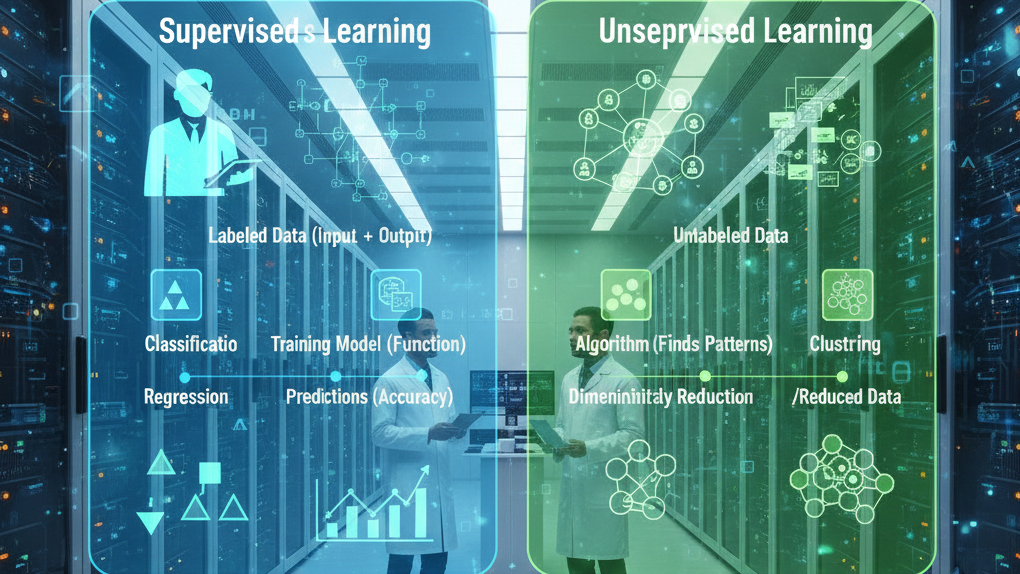
Complete machine learning guide — Machine learning guide 2026 is one of the most important topics in AI and automation in 2026. Meta Description: Understand the difference between supervised and unsupervised machine learning.
One of the first decisions you’ll face when starting your Machine Learning journey is choosing between supervised and unsupervised learning. These two fundamental approaches differ significantly in methodology, applications, and outcomes. Understanding their differences will help you select the right approach for your specific problem.
What Is Supervised Learning?
Supervised Learning operates under a clear framework: you have data with known answers, and the goal is to teach a model to predict these answers for new, unseen data.
How It Works
Think of it as learning with a teacher who provides correct answers. Your model learns by comparing its predictions to these known answers, adjusting its internal parameters to minimize errors.
Key components include Features which are the information given to the model, Labels which are the correct answers the model learns to predict, and Training Process where the model iteratively learns.
Real-World Example
Imagine building an email spam filter. You have thousands of emails, each labeled as “spam” or “legitimate.” You show these to your model, which learns the characteristics distinguishing spam from legitimate emails. Once trained, it can classify new emails accurately.
Common Applications
Medical Diagnosis predicts whether a patient has a disease. House Price Prediction estimates prices based on characteristics. Customer Churn Prediction identifies customers likely to leave. Image Classification recognizes objects or animals. Sentiment Analysis determines if reviews are positive or negative.
Popular Supervised Learning Algorithms
Linear Regression predicts continuous values with a linear relationship. Decision Trees make decisions through yes-no questions. Random Forests combine multiple decision trees. Support Vector Machines find optimal boundaries between classes. Neural Networks simulate brain-like learning.
Advantages of Supervised Learning
Typically achieves high accuracy, results are interpretable and understandable, and clear metrics exist for evaluating performance.
Disadvantages of Supervised Learning
Requires extensive labeled data which is expensive and time-consuming to create, labels may introduce human bias, and may not discover unexpected patterns.
What Is Unsupervised Learning?
Unsupervised Learning takes a different approach. Here, data comes without labels, and the model’s job is to discover hidden structures, patterns, or groupings independently.
How It Works
Instead of learning from correct answers, unsupervised learning explores the data itself. The model identifies similarities, differences, and patterns without predefined guidance, like an explorer discovering new territories without a map.
Key components include Features which are the information given to the model, No Labels which means the model operates without predefined correct answers, and Pattern Discovery where the algorithm identifies structures inherent in the data.
Real-World Example
Imagine a retail company with customer transaction data but no pre-labeled segments. An unsupervised learning algorithm might automatically group customers into clusters, perhaps identifying premium buyers, bargain hunters, and casual shoppers. These segments emerge naturally from the data.
Common Applications
Customer Segmentation groups customers by behavior for targeted marketing. Anomaly Detection identifies unusual patterns like fraudulent transactions. Data Compression reduces dimensions while preserving information. Recommendation Systems suggest products based on user preferences. Image Clustering organizes photos by similar content. Gene Sequencing finds patterns in genetic data.
Popular Unsupervised Learning Algorithms
K-Means Clustering divides data into K clusters around central points. Hierarchical Clustering creates a tree-like hierarchy of clusters. Principal Component Analysis reduces data dimensions. Autoencoders use neural networks to learn compressed representations. DBSCAN clusters based on density.
Advantages of Unsupervised Learning
Requires no expensive labeling process, can discover unexpected valuable patterns, useful for exploratory data analysis, and scalable to large, unlabeled datasets.
Disadvantages of Unsupervised Learning
Results can be harder to interpret and validate, no clear metrics for measuring success, requires domain expertise to evaluate if patterns are meaningful, and may find statistically significant but not practically useful patterns.
Head-to-Head Comparison
Supervised Learning uses labeled data with clear evaluation metrics for predicting known outcomes. Unsupervised Learning uses unlabeled data to discover hidden patterns without clear success metrics.
When to Use Each Approach
Choose Supervised Learning when you have clearly defined target variables, labels are available or can be obtained, you need high accuracy, or the problem is well-understood. Choose Unsupervised Learning when you have abundant unlabeled data, want to explore data without preconceptions, look for hidden patterns, or labeling is impractical.
Hybrid Approaches
Semi-Supervised Learning uses a small amount of labeled data combined with a larger amount of unlabeled data. Self-Supervised Learning creates labels automatically from the data itself.
Conclusion
Supervised and unsupervised learning represent two fundamental paradigms in Machine Learning. The choice between them depends on your data availability, problem definition, and business objectives. Ready to explore specific algorithms? Check out our guide on Regression and Classification Explained.
Continue learning
← Back to Machine Learning Essentials
Next: Regression and Classification Explained
Recurrent Neural Networks (RNNs) Explained
Meta Description: Explore RNNs, LSTMs, and their role in processing sequential data like text and time series.
While CNNs dominate image processing, Recurrent Neural Networks excel at sequential data where order matters. From translating languages to predicting stock prices, RNNs are essential.
Understanding Sequential Data
Sequential data includes Text where words depend on previous words, Time Series like stock prices and weather, and Audio including speech and music.
How RNNs Work
RNNs process sequences one element at a time, maintaining a hidden state or memory that captures information from previous steps. This allows them to understand context.
The Problem with Simple RNNs
Simple RNNs struggle with long sequences due to the vanishing gradient problem where they forget early information.
LSTMs and GRUs
Long Short-Term Memory and Gated Recurrent Units solve this by using gates to control what to remember and forget, enabling learning of long-term dependencies.
Applications
Machine Translation translates text between languages. Speech Recognition converts audio to text. Sentiment Analysis determines emotion in text. Text Generation writes creative content.
Conclusion
RNNs and variants are fundamental for any task involving sequences. They bring memory and context to AI models. Return to Deep Learning and Neural Networks to see the big picture.
Continue learning
← Back to Deep Learning and Neural Networks
Next: AI Applications Across Industries
What Are Neural Networks? Foundations & Architecture
Meta Description: Learn the basics of neural networks: structure, neurons, weights, and how they learn.
Neural Networks are at the heart of modern Artificial Intelligence. Yet their workings often seem mysterious and intimidating. This guide demystifies neural networks, explaining how they work, why they’re effective, and how you can start building them.
The Biological Inspiration
Neural networks are inspired by biological brains. Our brains contain roughly 86 billion neurons, each connected to thousands of others, forming a complex network that enables thought, learning, and action.
Artificial Neural Networks mimic this structure and function at a mathematical level. While simplified compared to biological brains, they capture essential principles enabling powerful learning.
Anatomy of a Neural Network
Neurons
Artificial neurons are mathematical functions. Each receives inputs, combines them using weights, adds a bias, and passes the result through an activation function.
Mathematically: output = activation(sum(inputs × weights) + bias)
Weights and Biases
Weights control how much each input contributes. Biases shift the activation function. Think of them as knobs the network tunes to solve problems.
How Neural Networks Learn: Backpropagation
Training involves three steps. Forward Propagation sends data through layers to produce predictions. Loss Calculation compares predictions to actual values to calculate error. Backpropagation propagates error gradients backward to update weights and minimize error.
Conclusion
Neural networks are powerful function approximators capable of learning complex patterns. Understanding their structure and training process is essential for working with Deep Learning. Explore Convolutional Neural Networks or return to the Deep Learning Pillar for more context.
Continue learning
← Back to Deep Learning and Neural Networks
Next: Convolutional Neural Networks Explained
Deep Learning: How Neural Networks Learn
Meta Description: Deep dive into deep learning, neural networks, and how they power modern AI applications.
Deep Learning represents one of the most powerful and transformative branches of Artificial Intelligence today. Unlike traditional Machine Learning algorithms that rely on hand-crafted features, Deep Learning systems automatically discover the representations needed for detection or classification from raw data. This revolutionary approach has powered breakthrough applications from defeating world chess champions to enabling autonomous vehicles.
If you’ve heard about ChatGPT, image recognition, voice assistants, or self-driving cars, you’re witnessing Deep Learning in action. This pillar article demystifies Deep Learning, exploring how neural networks learn from data and why they’re so effective for solving complex problems.
What Is Deep Learning?
Deep Learning is a subset of Machine Learning based on artificial neural networks with multiple layers, hence “deep”. These networks mimic the structure and function of biological brains, learning hierarchical representations of data.
Why “Deep”?
The term “deep” refers to the depth of the neural network, the number of layers between input and output. Shallow networks have few layers; deep networks have many. The layered architecture allows networks to learn increasingly abstract representations of data.
For example, a deep network analyzing images might learn low-level features like edges and colors in Layer 1, mid-level features like textures and shapes in Layer 2, and high-level features like facial features or objects in Layer 3, finally outputting a classification.
Understanding Neural Networks
Neural Networks are inspired by biological brains but are mathematical abstractions. Understanding their structure is key to grasping Deep Learning.
Components of a Neural Network
Neurons or Nodes are the basic computational units. Each receives inputs, applies weights, adds a bias, and passes through an activation function.
Weights are parameters that the network learns during training. They determine how much each input contributes to the neuron’s output.
Biases are additional parameters allowing neurons to shift activation functions, increasing model flexibility.
Layers are groups of neurons organized hierarchically with Input Layer receiving raw data, Hidden Layers processing information, and Output Layer producing predictions.
Why Deep Learning Is Powerful
Hierarchical Feature Learning
Deep networks automatically learn hierarchical features, eliminating the need for manual feature engineering, often the most time-consuming part of Machine Learning.
Non-Linear Relationships
Deep networks excel at capturing complex, non-linear relationships that simple models miss.
Scalability
Deep Learning scales with data and compute. More data and processing power lead to better performance.
Conclusion
Deep Learning has revolutionized AI, enabling machines to solve previously intractable problems. While challenging to master, the rewards—breakthrough applications, innovation, and career opportunities—make the journey worthwhile. Ready to explore specific architectures? Check out our guides on Convolutional Neural Networks for image tasks or Recurrent Neural Networks for sequential data.
Related articles
- What are Neural Networks?
- Convolutional Neural Networks Explained
- Recurrent Neural Networks Beginners
Regression and Classification: Core ML Algorithms
Meta Description: Learn how regression and classification algorithms work and when to use them.
Regression and Classification are the two pillars of supervised learning. While both are predictive models that learn from labeled data, they address different types of problems. Mastering both is essential for any Machine Learning practitioner.
Understanding Regression
Regression is used when you want to predict continuous numerical values. Continuous means values can fall anywhere on a spectrum, not just discrete categories.
How Regression Works
Imagine predicting house prices. Given features like square footage, bedrooms, and location, you want to estimate a price. The price could be 250,000 or 350,500 or any value in between, not just “cheap” or “expensive.”
Regression algorithms learn the underlying relationship between input features and continuous output values. The simplest form, Linear Regression, fits a line through data points to make predictions.
Real-World Regression Applications
Financial Forecasting predicts stock prices or market trends. Real Estate estimates property values. Healthcare predicts patient recovery times. Energy Consumption forecasts power usage. Salary Prediction estimates wages based on experience and education.
Common Regression Algorithms
Linear Regression assumes a linear relationship between inputs and output and is simple and interpretable. Polynomial Regression fits higher-degree polynomials for non-linear relationships. Support Vector Regression uses advanced techniques for complex, non-linear relationships. Decision Tree Regression splits data into regions assigning the average value of each region. Random Forest Regression combines multiple trees reducing overfitting.
Evaluating Regression Models
Mean Absolute Error shows the average absolute difference. Mean Squared Error penalizes larger errors more heavily. Root Mean Squared Error is in the same units as the target variable. R² Score measures how well the model explains variance.
Understanding Classification
Classification predicts which category an item belongs to. Unlike regression’s continuous values, classification outputs discrete categories or classes.
How Classification Works
Imagine building an email filter. An email must be classified as either “spam” or “legitimate”, nothing in between. Classification algorithms learn to distinguish between predefined categories based on features.
Real-World Classification Applications
Medical Diagnosis classifies tumors as benign or malignant. Fraud Detection identifies fraudulent vs. legitimate transactions. Sentiment Analysis classifies reviews as positive, negative, or neutral. Image Recognition identifies objects, faces, or animals. Spam Detection filters spam from legitimate emails. Customer Categorization segments customers as high-value, medium, or low-value.
Types of Classification
Binary Classification has two classes like spam or not spam. Multi-class Classification has more than two classes like cat, dog, or bird. Multi-label Classification allows instances to belong to multiple classes.
Common Classification Algorithms
Logistic Regression creates probability boundaries between classes and is interpretable for binary classification. Decision Trees recursively split data and are intuitive. Random Forests reduce overfitting by combining multiple trees. Support Vector Machines find optimal hyperplanes separating classes. Naive Bayes applies probability theory and is fast. K-Nearest Neighbors classifies based on nearest neighbors. Neural Networks handle complex patterns.
Evaluating Classification Models
Accuracy shows the percentage of correct predictions. Precision shows of predicted positives how many were actually positive. Recall shows of actual positives how many we caught. F1-Score balances precision and recall. Confusion Matrix shows true positives, true negatives, false positives, and false negatives. ROC Curve shows the trade-off between true positive and false positive rates.
Regression vs. Classification: Key Differences
Regression outputs continuous values, Classification outputs discrete categories. Regression predicts how much, Classification predicts which category.
When to Use Each
Use Regression when your target is continuous, you want exact values, the problem involves forecasting, or you’re doing estimation. Use Classification when your target is categorical, you want to assign categories, the problem involves categorization or detection.
Hybrid Scenarios
You can convert regression output to classes or use classification as intermediate steps for regression.
Conclusion
Regression and classification are fundamental tools in your Machine Learning toolkit. Regression answers how much, Classification answers which category. Ready to explore more algorithms? Check out our guide on Top Machine Learning Algorithms.
Continue learning
← Back to Machine Learning Essentials
Next: Top Machine Learning Algorithms
AI Applications Across Industries: Real-World Use Cases
Meta Description: How AI fosters automation and process improvement across major industries like healthcare, finance, and education.
Artificial Intelligence is no longer confined to research laboratories. It has become a transformative force reshaping industries across the globe, from healthcare and finance to education and manufacturing.
This comprehensive guide explores how AI is revolutionizing major sectors, the specific applications driving impact, and the real-world benefits organizations are achieving.
Healthcare: Saving Lives
AI represents a paradigm shift in medicine. Diagnostics where AI analyzes medical images faster and more accurately than humans. Drug Discovery accelerating the development of new medicines. Personalized Medicine tailoring treatments to individual genetic profiles.
Finance: Smarter Money
The financial sector was an early adopter. Fraud Detection spots suspicious transactions in real-time. Algorithmic Trading executes trades at superhuman speeds based on data. Risk Assessment provides better credit scoring and loan approval processes.
Education: Personalized Learning
AI is transforming how we learn. Adaptive Learning platforms adjust content difficulty based on student performance. Automated Grading saves teachers time to focus on mentoring. Intelligent Tutors provide 24/7 support.
Manufacturing & Retail
Predictive Maintenance predicts equipment failure before it happens. Recommendation Engines suggest products customers actually want. Supply Chain Optimization improves logistics and inventory management.
Conclusion
AI’s applications are vast and growing. Organizations adopting AI gain efficiency, innovation, and competitive advantage. Explore specific industries: AI in Healthcare, AI in Finance, or AI in Education.