
The ultimate guide to marketing is one of the most important topics in AI and automation in 2026. In today’s entrepreneurial landscape, growth is no longer a matter of luck or isolated creative genius. It is a matter of engineering. As we enter an era dominated by agentic Artificial Intelligence, the gap between market leaders and stagnating businesses lies in their ability to build autonomous systems. The era of manual marketing is officially over. Today, predictability is the byproduct of a well-designed automation architecture.
This guide explores the profound strategies required to transform your marketing into a high-performance engine capable of generating revenue autonomously, scalably, and above all, predictably.
I. The Marketing Mutation: From Funnels to Flywheels
The traditional sales funnel concept (Awareness, Consideration, Conversion) has become obsolete because it is linear and suffers from significant leakage at every stage. In 2026, high-performing enterprises have adopted the “Flywheel” model.
In this model, automation acts as a lubricant that reduces friction, while AI serves as the motor that accelerates rotation. Instead of spending energy to acquire every new customer from scratch, automation repurposes the energy of existing customers to attract new ones. A satisfied customer, integrated into an automated referral loop or an AI-managed testimonial system, becomes a passive acquisition lever.
II. Orchestration at the Core: The n8n Revolution
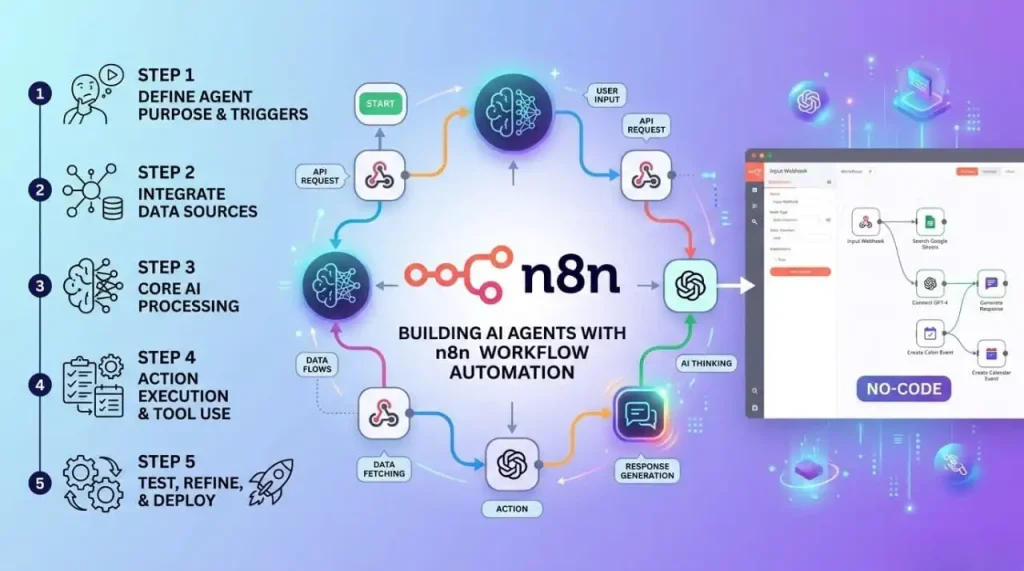
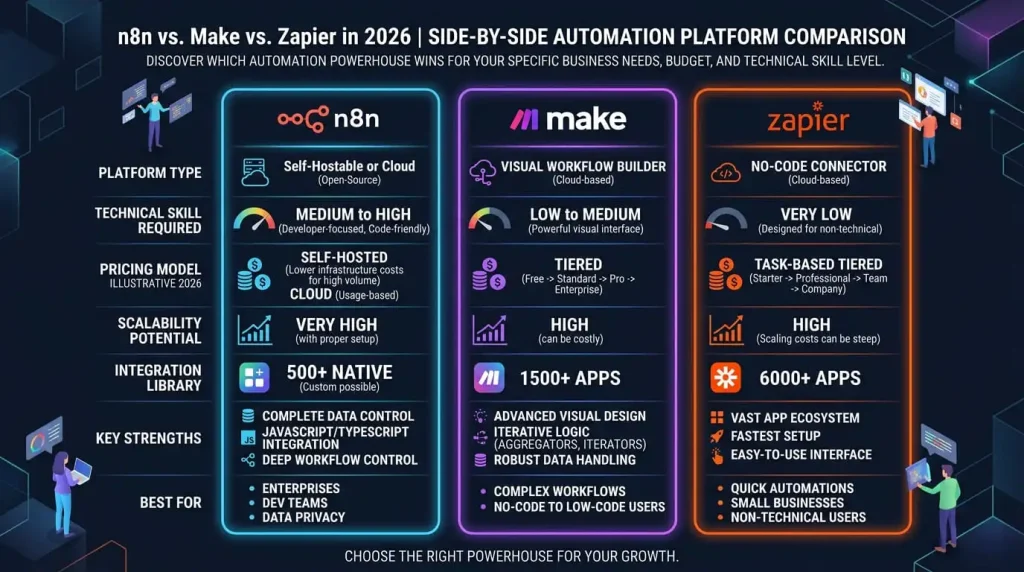
For automation to be truly effective, it must do more than simply connect two applications. It must be capable of making complex decisions. This is where orchestration comes into play. Tools like n8n have redefined industry standards, surpassing the simplistic “if-this-then-that” solutions of the past.
Orchestration allows for the creation of a true “central intelligence.” For example, when a prospect interacts with an advertisement, the system does not just send an email. It triggers a cascade of invisible actions:
- Instant Enrichment: An AI scans the prospect’s LinkedIn profile and company website.
- Predictive Scoring: Algorithms evaluate purchase potential based on company size and current industry news.
- Intelligent Routing: If the score is high, a sales representative is alerted on Slack with a comprehensive brief prepared by ChatGPT. If the score is low, the prospect is placed into an automated “Nurturing” educational sequence.
III. Autonomous Agents: Your New Digital Workforce
One of the most significant breakthroughs this year is the integration of autonomous agents like Manus. Unlike classic software that executes fixed tasks, these agents are given a goal and determine the best path to achieve it themselves.
In a growth strategy, these agents can manage entire segments of the business:
- Autonomous Prospecting: An agent can identify targets, discover their specific pain points by reading their latest annual reports, and draft a personalized outreach strategy—all without human intervention.
- Competitive Intelligence: They monitor price changes and strategic shifts from your competitors in real-time, dynamically adjusting your own advertising campaigns or pricing.
- Pre-Sales Support: Agents no longer just answer questions; they guide the user toward the ideal product, handle complex objections, and even pre-fill contracts.
IV. Hyper-Personalization: The End of Mass Marketing
The 2026 consumer rejects generic marketing. Modern automation allows for a “surgical” level of personalization at a massive scale. Thanks to the fusion between Large Language Models (LLMs) and creative tools like Photoshop-IA, every prospect can receive a unique visual and textual experience.
Imagine a retargeting campaign where the ad image isn’t a stock photo, but a real-time creation showing the prospect’s own logo integrated onto your product. This level of detail, once reserved for “Enterprise” accounts with massive budgets, is now accessible to all businesses through automated creative workflows.
V. Automated Retention: Guaranteeing Lifetime Value (LTV)
Predictable growth does not rely solely on acquisition, but on the ability to keep customers. Automated retention uses behavioral analysis to prevent customer churn before it happens. Algorithms monitor disengagement signals: a drop in login frequency, a reduction in the use of key features, or a payment delay. Before the customer even decides to leave, the system automatically triggers a loyalty offer or schedules a courtesy call with an account manager.
VI. How to Get Started: The Roadmap to Excellence
To build this architecture, a company must follow three key steps:
- Workflow Audit: Identify every repetitive task that takes your team more than 15 minutes a day. This is your primary automation pool.
- Selecting the Tech Stack: Prioritize open and interconnectable tools. A closed system is a dead system in the long run.
- Continuous Training: Technology evolves weekly. Programs like the Manus Academy are essential to ensure your teams are not just users, but architects capable of maintaining and improving these systems.
Conclusion: Automation as an Unfair Advantage
Marketing automation is no longer a luxury for tech companies; it is the immune system and growth engine of any business that wishes to survive the decade. By liberating humans from repetitive tasks, you allow them to focus on what AI cannot yet replace: empathy, high-level strategy, and pure creativity.
Investing in an automation architecture today is buying insurance for tomorrow’s growth. The future belongs to those who automate the ordinary to accomplish the extraordinary.
Expand Your Knowledge on AIWiner:
- Mastering n8n: How to replace expensive SaaS subscriptions with self-hosted orchestration.
- The Era of Manus Agents: A practical guide to delegating your prospecting to autonomous AI agents.
- Generative Design & SEO: Using Photoshop within ChatGPT to create visuals that convert.
- 2026 Data Strategy: Why your data quality is the limiting factor of your automation success.