
Which AI Is Best in 2026: Grok, ChatGPT, or Claude?
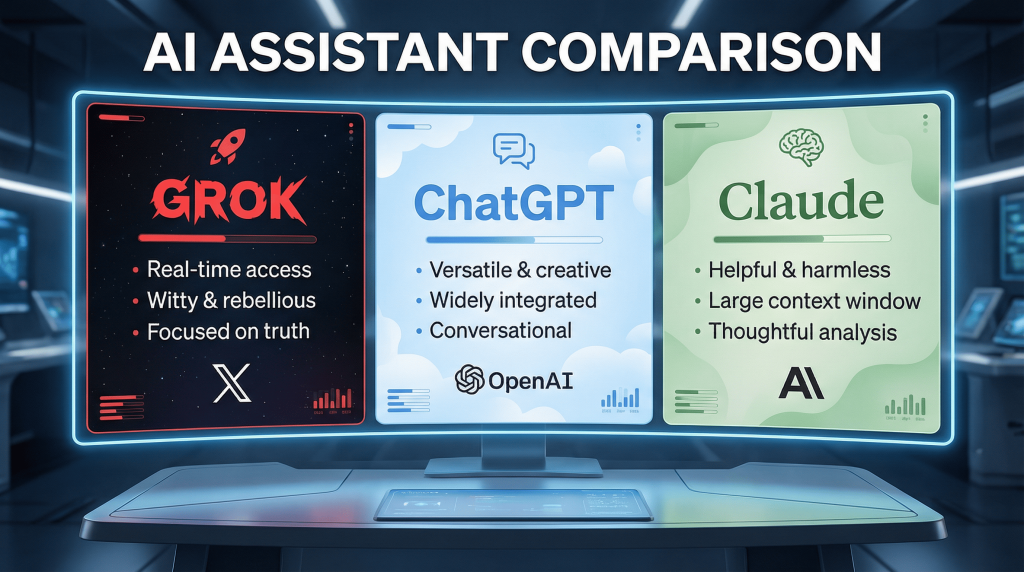
Grok vs chatgpt vs claude is one of the most important topics in AI and automation in 2026. Claude leads for reasoning, long-document analysis, and coding quality. ChatGPT (GPT-4o and o3) leads for image generation, plugin ecosystem, and general versatility. Grok leads for real-time X/Twitter data and speed benchmarks. The correct answer for most users: use Claude for serious work, ChatGPT for multimedia tasks, and Grok when you need live social data. No single model wins every category — the right choice depends on your specific use case.
Last month, I ran the same complex task through all three platforms: analyze a 50-page market research report, identify key trends, flag contradictions, and generate strategic recommendations. The differences weren’t subtle.
ChatGPT produced a thorough, well-structured analysis that felt like it came from a competent consultant. Claude delivered nuanced insights with careful reasoning and highlighted where the data might be misleading. Grok generated a witty, unfiltered assessment that called out obvious BS in the report and made recommendations ChatGPT would never dare suggest.
All three reached similar conclusions, but the journey getting there revealed fundamental differences in how these AI systems think, communicate, and serve different user needs.
After three months of intensive testing across dozens of use cases—from creative writing to code generation to business analysis—clear patterns have emerged about when each platform excels and when alternatives work better. This isn’t about declaring a “winner.” It’s about understanding which tool fits which job.
This guide provides detailed, honest comparison across everything that matters: reasoning and intelligence capabilities, content generation quality, real-time information access, safety and content policies, pricing and value proposition, and integration and ecosystem maturity.
Whether you’re choosing one platform for personal use, evaluating AI tools for your team, or just trying to understand what differentiates these systems beyond marketing hype, you’ll find objective analysis here based on extensive real-world testing. For deeper context on Grok specifically, see our complete Grok AI guide.
Core Architecture: How They Actually Work
Understanding the technical foundations explains why these systems behave differently.
ChatGPT: The Mature Generalist
ChatGPT runs on OpenAI’s GPT-4 and GPT-4 Turbo architectures, with the newer o1 and o3 reasoning models available for complex tasks. The platform has evolved through years of refinement, billions of dollars in training investment, and feedback from hundreds of millions of users.
Key technical advantages include massive training datasets spanning diverse domains, sophisticated fine-tuning for helpfulness and accuracy, advanced reasoning capabilities with the o-series models, and mature safety systems that filter harmful outputs.
The architecture prioritizes being helpful, harmless, and honest—in that order. This design philosophy shapes every interaction, making ChatGPT reliably professional but occasionally frustratingly cautious.
Claude: The Thoughtful Analyst
Claude, developed by Anthropic, uses the Claude 3.5 Sonnet and Claude Opus 4 architectures as of February 2026. Anthropic’s focus on “Constitutional AI” means Claude is trained to be helpful and harmless through explicit value alignment rather than just filtering harmful outputs.
Key differentiators include extended context windows (up to 200K tokens for some tasks), sophisticated multi-step reasoning, strong ethical reasoning and nuance handling, and advanced analysis capabilities for complex documents.
Claude excels at tasks requiring careful thinking, nuanced judgment, and handling of ambiguous situations. The system is designed to think through problems step-by-step rather than jumping to quick answers.
Grok: The Real-Time Provocateur
Grok utilizes the Grok-4 architecture trained by xAI, with Grok-4 Heavy for complex tasks and Grok-3 Mini for faster responses. The platform’s distinguishing feature is direct integration with X (Twitter) for real-time information access.
Key advantages include live data access from X’s firehose, training explicitly for wit and personality, minimal content filtering compared to competitors, and architecture optimized for current events and trends.
Grok is designed to be interesting and truthful over being safe and careful. This creates notably different interaction patterns that some users love and others find inappropriate.
Intelligence and Reasoning: The Benchmark Battle
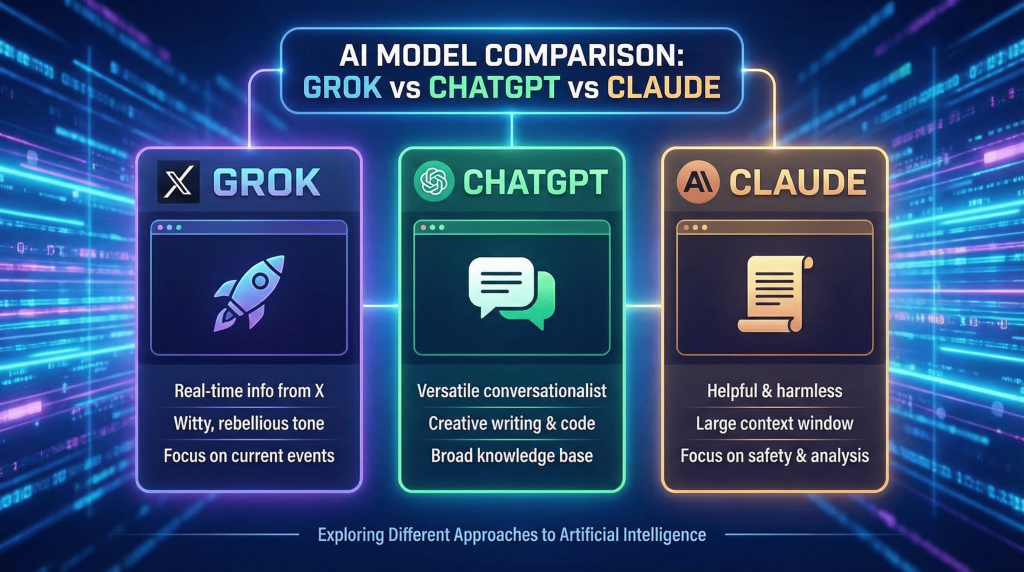
Let’s look at actual performance on standardized tests and real-world tasks.
Mathematical and Logical Reasoning
On the AIME (American Invitational Mathematics Examination), a rigorous high school math competition:
- Grok 3: Outperformed GPT-4o
- ChatGPT with o3-mini: Strong performance on logical proofs
- Claude Opus 4: Competitive but slightly behind on pure math
For PhD-level science problems (GPQA benchmark):
- Grok 3: Led among tested models
- Claude Opus 4: Strong second, particularly for problems requiring nuanced understanding
- ChatGPT GPT-4: Solid performance but behind the leaders
Winner: Grok for pure mathematical reasoning, Claude for scientific reasoning requiring context.
Complex Multi-Step Reasoning
I tested all three with a business strategy problem requiring multiple reasoning steps:
“A retail company with declining in-store sales but growing online revenue needs to decide whether to close physical locations, invest in omnichannel integration, or double down on e-commerce. They have $5M to invest, 200 employees, and must show profit improvement within 18 months. Analyze and recommend.”
ChatGPT’s approach: Systematic analysis of each option, clear pros/cons lists, financial modeling for each scenario, recommendation with implementation steps. Professional, thorough, like a consultant’s deck.
Claude’s approach: Deep analysis of underlying customer behavior changes, careful consideration of employee impact and morale, nuanced discussion of risks inherent in each path, recommendation with multiple contingency plans based on different outcomes.
Grok’s approach: Blunt assessment that closing stores without understanding WHY customers prefer online is backwards, analysis of X conversations about retail experiences showing customers want fast fulfillment not more stores, recommendation combining micro-fulfillment centers with online presence while gradually reducing retail footprint.
All three reached similar conclusions (omnichannel integration with gradual store reduction), but the thinking process differed markedly.
Winner: Claude for problems requiring careful reasoning, Grok when current market sentiment matters, ChatGPT for structured business analysis.
Creative Problem-Solving
For creative tasks requiring novel thinking rather than logical reasoning:
Test: “Design a marketing campaign for sustainable fashion targeting Gen Z with a $50K budget.”
ChatGPT: Generated comprehensive campaign plan with social media strategy, influencer partnerships, content calendar, and budget breakdown. Professional and thorough but fairly conventional.
Claude: Developed strategy emphasizing authentic storytelling, analyzed potential greenwashing pitfalls, suggested community-building approach over traditional advertising, flagged ethical considerations in influencer selection.
Grok: Identified trending sustainability conversations on X, suggested meme-driven campaign piggybacking on existing discourse, recommended controversial stance-taking to generate organic engagement, proposed budget allocation favoring micro-influencers over established names based on current X engagement patterns.
Winner: Depends on your creative philosophy—Grok for bold/trendy, Claude for thoughtful/ethical, ChatGPT for structured/proven.
Content Generation: Writing, Coding, and Creation
Let’s compare practical content creation across different domains.
Professional Writing (Articles, Reports, Documentation)
For business writing, technical documentation, and professional communications:
ChatGPT produces polished, well-structured content that reads professionally. The tone is appropriate for business contexts, formatting is clean and logical, and quality is consistent across topics. It’s the safest choice for professional environments.
Claude generates equally polished content with more sophisticated vocabulary and complex sentence structures. The writing shows deeper analysis and nuance. It excels at content requiring thoughtful argument or careful reasoning.
Grok creates readable content with more casual tone even when you request formal style. The writing is clear but sometimes inappropriately informal for serious business contexts. Better for blogs and casual content than corporate communications.
Winner: ChatGPT for business, Claude for analytical writing, Grok for casual content.
Creative Writing (Fiction, Storytelling)
For creative projects, character development, and storytelling:
ChatGPT generates competent but often generic creative writing. It follows conventional story structures well but rarely surprises. Characters can feel formulaic. Useful for drafting but needs significant human editing.
Claude produces more nuanced character psychology and can handle complex narrative structures. The writing shows better understanding of literary techniques and can mimic different authors’ styles effectively.
Grok delivers unexpected and sometimes brilliant creative angles. The unfiltered nature means it explores edgier themes. Characters feel more real because they’re less sanitized. However, quality varies more—brilliant or mediocre, rarely just good.
Winner: Claude for sophisticated fiction, Grok for edgy/experimental work, ChatGPT for structured commercial fiction.
Code Generation and Programming
For software development, debugging, and technical problem-solving:
ChatGPT offers mature code generation with broad language support, good documentation and explanation, solid debugging capabilities, and extensive examples for common tasks. The ecosystem includes GitHub Copilot integration.
Claude generates clean, well-commented code with strong architecture understanding, excellent at explaining complex codebases, thoughtful about edge cases and error handling, and good at refactoring suggestions.
Grok provides competent code generation competitive with ChatGPT, particularly strong for gaming and technical questions (engineers specifically improved this), and growing capabilities but less ecosystem maturity.
Winner: ChatGPT for ecosystem and breadth, Claude for code quality and architecture, Grok as solid alternative.
Marketing and Sales Copy
For persuasive writing, ad copy, and sales materials:
ChatGPT creates effective marketing copy following proven patterns. It understands conversion optimization principles and generates multiple variations for testing. The output is professional and ready to use with minor editing.
Claude produces more sophisticated marketing copy with better psychological insight. It’s particularly strong at long-form sales content and thought leadership pieces. The writing avoids obvious clichés better than alternatives.
Grok generates trendy, zeitgeist-aware marketing that feels current. Its X integration means copy reflects what’s actually working in real-time social conversations. The style is more casual and attention-grabbing but may not suit conservative brands.
Winner: ChatGPT for tested approaches, Claude for sophisticated audiences, Grok for trend-driven campaigns.
Real-Time Information: The Decisive Difference
This is where Grok’s architecture creates insurmountable advantages for specific use cases.
Current Events and Breaking News
For questions about today’s news, ongoing developments, or recent events:
ChatGPT knows its training cutoff (varies by model, typically several months old) and can’t access current information without plugins or external search. It will honestly tell you it doesn’t know about recent events.
Claude similarly has fixed training data and requires external search for current information. However, it’s good at identifying when a question likely requires current data and suggesting you verify elsewhere.
Grok directly accesses real-time X conversations and can synthesize breaking news as it unfolds, track how stories develop hour-by-hour, identify emerging trends before they’re widely reported, and provide diverse perspectives from ongoing discussions.
For anyone whose work involves current events—journalists, traders, researchers, policy analysts—Grok’s real-time access represents genuine utility competitors can’t match.
Test case: I asked all three about a major corporate announcement that happened six hours prior to testing.
- ChatGPT: “I don’t have information about events after my training cutoff”
- Claude: “I can’t access current news, but I can help you analyze the implications if you share the announcement”
- Grok: [Provided detailed summary of the announcement with reactions from analysts, investors, and industry experts based on X discussions]
Winner: Grok decisively.
Market Research and Trend Analysis
For understanding what people are talking about, what’s trending, and sentiment analysis:
ChatGPT can analyze historical trends from its training data but can’t tell you what’s trending today. Useful for establishing patterns but not current state.
Claude similarly strong for analyzing provided data but can’t access current sentiment or trends without external input.
Grok monitors ongoing conversations on X, identifies emerging trends before they become mainstream, analyzes sentiment across demographics and communities, and tracks how conversations evolve over time.
For marketers, product teams, or anyone whose work depends on understanding current public sentiment, Grok provides unique value.
Winner: Grok for current trends, Claude for analyzing historical patterns, ChatGPT for established knowledge.
Safety, Content Policies, and Filtering
This differentiator causes the most heated debate. Let’s be objective about trade-offs.
ChatGPT: Balanced Safety
ChatGPT’s content policies aim for middle ground between utility and safety:
- Refuses requests for illegal content, graphic violence, sexual content involving minors, detailed instructions for harming people, and non-consensual intimate imagery
- Engages with controversial topics but with disclaimers and balanced perspectives
- Filters outputs for potentially harmful content but less aggressively than Claude
- Allows discussion of sensitive subjects in educational or analytical contexts
For most business and personal use, ChatGPT’s policies provide adequate freedom while preventing the worst abuse cases. The occasional refusal frustrates users but isn’t frequent enough to be debilitating.
Claude: Maximum Safety
Claude has the strictest content policies and most aggressive filtering:
- Refuses engagement with controversial topics more readily than competitors
- Won’t generate potentially harmful content even for legitimate use cases
- Heavily filters language and topics to avoid anything remotely offensive
- Prioritizes safety over utility when conflicts arise
For enterprise environments with strict compliance requirements or conservative risk tolerance, Claude’s caution is advantageous. For creative work or research touching on difficult topics, it’s limiting.
Grok: Minimal Filtering
Grok’s approach prioritizes openness over safety:
- Minimal content restrictions (especially in Spicy mode)
- Engages with controversial topics without heavy disclaimer language
- Allows discussion and generation of content other platforms block
- Relies on user responsibility rather than system prevention
This creates both opportunities (creative freedom, honest engagement with difficult topics) and risks (potential for harmful content generation if misused).
The Honest Assessment:
There’s no objectively “correct” level of filtering. The right choice depends on your values, use cases, and risk tolerance:
- Choose Claude if safety is paramount and you can’t afford any potentially problematic outputs
- Choose ChatGPT if you want balance between utility and safety
- Choose Grok if you value unfiltered access and are willing to use it responsibly
Pricing and Value: The Economic Reality
Cost matters for individuals and becomes critical at scale. Let’s break down the real economics.
Individual User Costs
For personal use with moderate volume:
- ChatGPT Plus: $20/month (GPT-4 access, DALL-E, plugins)
- Claude Pro: $20/month (Claude Opus 4, higher usage limits)
- Grok via X Premium: $8-16/month (Grok + X features)
If you want one tool: Grok via X Premium offers most capability at lowest cost.
If you want best capability: ChatGPT or Claude at $20/month provide more mature features.
If you want multiple tools: Getting both ChatGPT and Claude Pro ($40/month) covers more use cases than any single platform.
Team and Business Costs
For teams of 5-50 people:
ChatGPT Teams: $25-30/user/month with centralized billing, admin controls, and some enterprise features.
Claude for Teams: $25-30/user/month with similar enterprise features and compliance options.
Grok for teams: Less mature team offerings. Individual subscriptions work but lack centralized management.
At this scale, ChatGPT and Claude are comparably priced. Grok saves money if team members use X anyway but lacks enterprise administration tools.
Enterprise Scale
For large organizations (100+ users):
ChatGPT Enterprise: Custom pricing (reportedly $60-100/user/month) with dedicated support, SSO, advanced security, and custom model fine-tuning.
Claude for Enterprise: Similar pricing structure with compliance certifications and dedicated infrastructure options.
Grok Enterprise: Less developed enterprise offering. Suitable for forward-thinking companies willing to work with newer platforms, less so for conservative enterprises needing mature support.
Winner: Grok for individuals, tie between ChatGPT and Claude for enterprises, ChatGPT for the most mature ecosystem.
Integration, Ecosystem, and Developer Experience
For businesses, integration capabilities often matter more than raw AI performance.
API Maturity and Documentation
ChatGPT has the most mature API with extensive documentation, numerous code examples, active developer community, and broad third-party tool integration. If you’re building products on top of AI, OpenAI’s ecosystem is most developed.
Claude offers a professional-grade API with excellent documentation, growing rapidly in enterprise adoption, and strong focus on developer experience. The API is newer than OpenAI’s but high quality.
Grok has a functional API but less mature documentation, smaller developer community, and fewer third-party integrations. Improving rapidly but currently behind established competitors.
Winner: ChatGPT decisively, Claude second, Grok developing.
Platform Integrations
ChatGPT integrates with Microsoft 365 (through Copilot), Google Workspace (through Gemini, though that’s technically a different model), Slack, Zapier, and hundreds of other platforms.
Claude integrates with Notion, Slack, and growing list of enterprise tools. Anthropic focuses on high-value integrations rather than breadth.
Grok tightly integrates with X and gradually adding other platforms. Tesla integration announced but not fully deployed. Ecosystem is smallest but growing.
Winner: ChatGPT for breadth, Claude for targeted enterprise integration, Grok for X ecosystem only.
Use Case Recommendations: Which Tool for Which Job
After extensive testing, here’s honest guidance about optimal tool selection by use case.
For Content Creators and Writers
- Blog posts and articles: ChatGPT for volume, Claude for sophistication
- Social media content: Grok (understands current trends)
- Creative fiction: Claude for quality, Grok for experimental
- Technical documentation: ChatGPT or Claude equally strong
For Developers and Technical Work
- Code generation: ChatGPT (ecosystem maturity)
- Code review and refactoring: Claude (thoughtful analysis)
- Technical problem-solving: Any of the three work well
- API integration: ChatGPT (best documentation)
For Business and Strategy
- Market research: Grok (real-time data)
- Strategic analysis: Claude (nuanced reasoning)
- Presentation creation: ChatGPT (structured outputs)
- Competitive intelligence: Grok (current sentiment tracking)
For Education and Research
- Research assistance: Claude (careful reasoning)
- Current events: Grok (real-time information)
- Explaining concepts: ChatGPT (clear explanations)
- Academic writing: Claude (sophisticated analysis)
For Marketing and Sales
- Campaign ideation: Grok (trend awareness)
- Copy generation: ChatGPT (proven patterns)
- Audience analysis: Grok (real-time sentiment)
- Long-form content: Claude (depth and sophistication)
Conclusion: The Multi-Tool Reality
After months of intensive comparison, the honest conclusion is that no single platform wins across all dimensions. Each has genuine strengths that matter for different users and use cases.
ChatGPT remains the most mature, broadly capable, well-integrated option. It’s the safe choice for businesses, the best starting point for newcomers, and the strongest ecosystem for developers.
Claude excels at sophisticated analysis, careful reasoning, and work requiring nuance and ethical consideration. It’s ideal for professional work requiring thoughtful outputs and compliance-conscious organizations.
Grok provides unique value through real-time information access, minimal content filtering, and cost-effectiveness. It’s perfect for work involving current events, users frustrated by competitor restrictions, and anyone wanting maximum capability per dollar.
The smart approach many professionals adopt: use multiple tools strategically. Grok for current information and trend analysis, ChatGPT for content generation and coding, and Claude for complex analysis and sensitive work.
You’re not locked into one platform. Subscriptions are affordable enough that using 2-3 tools based on their strengths makes sense for anyone using AI extensively.
The broader truth: we’re past the phase where one AI dominates everything. Specialized tools for specialized purposes will increasingly be the norm. Understanding which tool excels at what becomes a core professional skill in the AI era.
Choose tools based on actual capabilities for your specific needs, not marketing hype or tribal loyalty to one company. That pragmatic approach will serve you better than trying to force one tool to do everything.
Related Resources:
- Grok AI: Complete Guide 2026 – Comprehensive overview of Grok’s full capabilities, controversies, and use cases.
- Grok Imagine: AI Image & Video Generation Guide – Detailed guide to Grok’s creative generation capabilities.
- Is Grok Worth It? Pricing, Features & Real Review – Honest assessment of whether Grok justifies the subscription cost.