
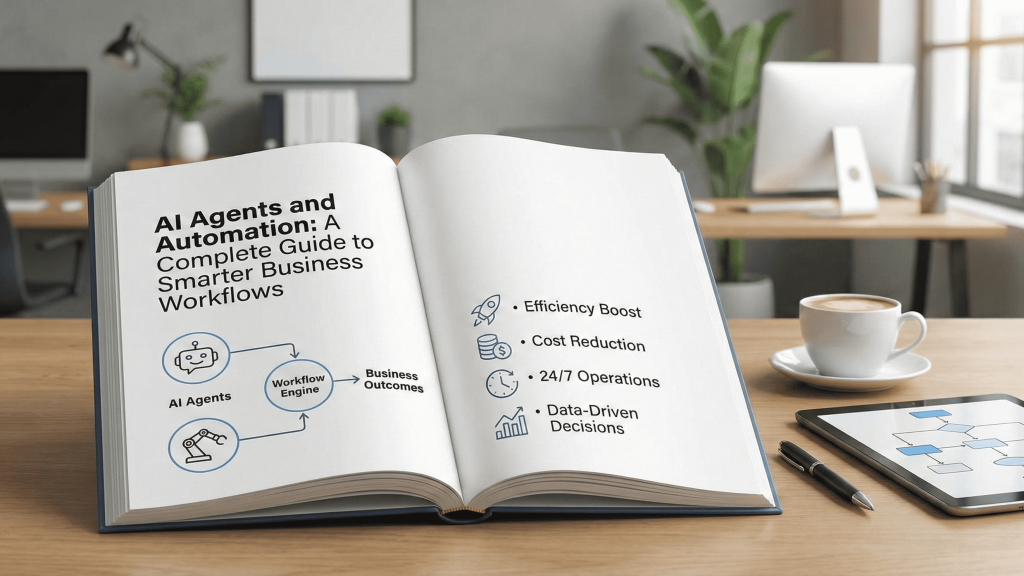
The way companies work is changing fast. In the past, automation meant simple scripts or fixed rule engines that handled only repetitive tasks. Today, a new layer of automation is emerging: AI agents. These are software programs that can understand a goal, gather the information they need, decide what to do, and then execute that decision inside your systems with very little human help.
An AI agent is not just a chatbot that answers questions. It behaves more like a digital employee that operates under clear rules and limits. In customer support, for example, a single agent can receive a ticket, search the knowledge base, check the order history, decide on the best resolution, execute the action, and then write a full reply for the customer. Humans only step in when the case is complex or sensitive.
The Difference Between a Chatbot and an AI Agent
A traditional chatbot follows a simple question–answer pattern. It waits for a message, then tries to match it with a scripted response or generates one with a language model. It usually has very limited access to internal systems and almost never initiates actions by itself.
An AI agent, by contrast, works toward a clearly defined objective such as “resolve as many tickets as possible within two hours with minimal escalations.” It can call APIs, read and update databases, create tasks, and trigger workflows, as long as all of that is inside its allowed permissions. The key shift is moving from “a bot that responds” to “a digital worker that gets a job done from start to finish.”
The Agent Lifecycle Inside a Business Process
A practical AI agent goes through four repeating stages:
- Understand and gather data: it reads the user request and conversation history, pulls account and order data, and queries internal systems for everything it needs.
- Plan and decide: it evaluates the available options based on company rules and constraints, then chooses the best path.
- Act and execute: it carries out what it decided, for example creating a return request, changing a delivery date, or updating the ticket status.
- Monitor and improve: it logs each step, tracks outcomes, and surfaces patterns that suggest what to improve in the rules or knowledge base.
In this way the agent becomes a smart layer on top of your existing systems, connecting data and turning it into faster, more consistent decisions.
Main Types of AI Agents in Companies
In real use, you typically combine several types of agents:
- Reflex agent: follows simple “if–then” rules, perfect for very frequent and predictable questions such as “Where is my order?”
- Goal‑based agent: works toward a defined objective like reducing resolution time or minimizing shipping cost.
- Utility‑based agent: compares different options and chooses the one that maximizes a utility score (for example, balancing customer satisfaction, cost, and time).
- Multi‑agent system: several specialist agents working together, such as an inventory agent, a shipping agent, and a billing agent coordinated by a main “orchestrator” agent.
Real‑World Examples in Customer Service and Supply Chains
Modern contact centers using advanced AI agents report that 60–80% of simple first‑line tickets can be fully automated. That reduces human ticket volume dramatically and shortens response times while keeping satisfaction high. In supply chains, multi‑agent systems coordinate orders, stock checks, carrier selection, and invoicing, often reducing order cycle time from days to hours.
Challenges: Data, Security, and Team Adoption
Success is not just about having a powerful model. Agents depend on clean, up‑to‑date data; if your data is messy, their decisions will be unreliable or they will escalate too often. Security is another core issue, because agents touch sensitive information and can perform real actions. You need strict permission boundaries: what the agent can do, what it must never touch, and when it must escalate. Finally, people may worry that agents will “take their jobs”, so you must communicate clearly that the goal is to remove low‑value repetitive work and let humans focus on complex, human‑centric tasks.