
AI can scale marketing fast—but it can also scale mistakes fast: misleading claims, biased targeting, privacy violations, and inaccurate content.
In 2026, “AI ethics” isn’t a philosophical topic. It directly impacts:
- Trust (brand reputation, customer loyalty),
- Compliance (GDPR/CCPA and upcoming AI regulations),
- Performance (better data hygiene, fewer ad rejections, higher conversion quality),
- E‑E‑A‑T (expertise and reliability signals).
For the global strategy view, read the pillar:
➡️ AI Redefines Digital Marketing: Winning Strategies
1) Risk — Personal data, privacy, and compliance (GDPR/CCPA)
The problem
Marketing teams often feed AI tools with:
- customer lists,
- CRM notes,
- support conversations,
- email content with personal identifiers.
If this data is handled incorrectly, you can breach:
- GDPR (EU/UK),
- CCPA/CPRA (California),
- sector requirements (health, finance, minors).
Practical solutions (marketing-friendly)
A) Data minimization (default rule)
Only share what you truly need. Replace:
- full names → user IDs,
- email addresses → hashed emails,
- raw chat logs → anonymized summaries.
B) Don’t send sensitive data to generic tools
Avoid sending:
- payment details,
- medical data,
- private support tickets,
- personal addresses,
into consumer AI tools unless you have a clear DPA / enterprise agreement.
C) Consent + purpose limitation
Make sure users understand:
- what data is collected,
- why it’s collected,
- how it’s used (including AI-assisted processing).
D) Vendor due diligence
Before using an AI provider, check:
- Where data is processed and stored,
- Retention policy,
- “Training on your data” settings (opt-out if possible),
- Security standards.
✅ If you’re using AI in CRM workflows, keep your segmentation lawful and clean:
➡️ Personalization at Scale: How AI Improves CRM
2) Risk — Hallucinations, fake facts, and “source-less” content
The problem
Generative AI can create confident statements that are wrong:
- invented statistics,
- fake study references,
- incorrect feature claims,
- exaggerated performance promises.
In marketing, that becomes:
- reputational risk,
- legal risk (false advertising),
- SEO risk (thin/unreliable content).
Practical solutions
A) Build a “no-stat-without-source” rule
If a number is included, it must come from:
- internal analytics,
- a verifiable public source,
- a cited study with a real link.
B) Prefer “process + examples” over unverified stats
Instead of “brands increased ROI by 43%,” say:
- “Here’s the step-by-step system we used”
- “Here’s how to measure ROI in your context”
C) Use a QA checklist for AI-written content
Before publishing:
- Verify each claim that sounds “too perfect”
- Check product features (screenshots help)
- Ask: “Could a competitor challenge this?”
For a complete AI content workflow + QA system:
➡️ AI for Content Creation: Tools & Best Practices
3) Risk — Bias and discrimination in targeting, scoring, and personalization
The problem
AI-driven segmentation and lead scoring can unintentionally:
- exclude certain groups,
- amplify existing biases in historical data,
- optimize only for short-term conversions and ignore fairness.
Examples:
- A lead scoring model favoring one region because past sales focused there.
- Ad delivery optimizing toward a narrow demographic due to better CTR.
Practical solutions
A) Audit your segments and scores
Every month (or quarter), check:
- who gets classified as “low value”
- who receives fewer offers
- who never sees certain ads
B) Avoid proxies for sensitive attributes
Even if you don’t use sensitive categories directly, proxies can appear:
- zip codes,
- language,
- device type,
- income-related behaviors.
C) Add guardrails
Examples of guardrails:
- minimum exposure rules (don’t completely exclude segments),
- manual review for high-impact decisions (credit/financial offers),
- business rules overriding AI (e.g., always treat renewals carefully).
If you want to use predictive audiences ethically and profitably:
➡️ Predictive Analytics with AI: Forecasting Marketing Trends
4) Risk — Intellectual property (copyright), plagiarism, and brand ownership
The problem
AI can generate:
- text similar to competitors,
- images too close to copyrighted styles,
- designs that are hard to license clearly.
This is especially risky in:
- paid ads (platform policy),
- product pages,
- brand campaigns.
Practical solutions
A) Avoid “copy competitor” prompts
Never ask: “Rewrite this competitor page.”
Instead: “Write a page with this structure and our unique proof points.”
B) Use licensed assets when it matters
For high-visibility campaigns:
- use stock libraries with clear licenses,
- create your own brand visuals,
- keep documentation of asset origin.
C) Keep a “proof folder”
Store:
- creative briefs,
- final assets,
- dates of creation,
- tools used,
- original inputs (where applicable).
5) Risk — Transparency, disclosure, and brand trust
The problem
Users increasingly detect AI-generated content—and they don’t always hate it.
They hate it when:
- it feels deceptive,
- it hides limitations,
- it pretends to be “human expertise” without proof.
Practical solutions
A) Decide your disclosure level
Options:
- light disclosure (“AI-assisted, human-reviewed”)
- full transparency (especially in regulated sectors)
B) Don’t fake identity
Avoid:
- fake “customer testimonials” generated by AI,
- fake expert quotes,
- AI-written reviews presented as real users.
C) Make “human review” real
Assign a name/role internally:
- who validates claims,
- who validates compliance,
- who approves publishing.
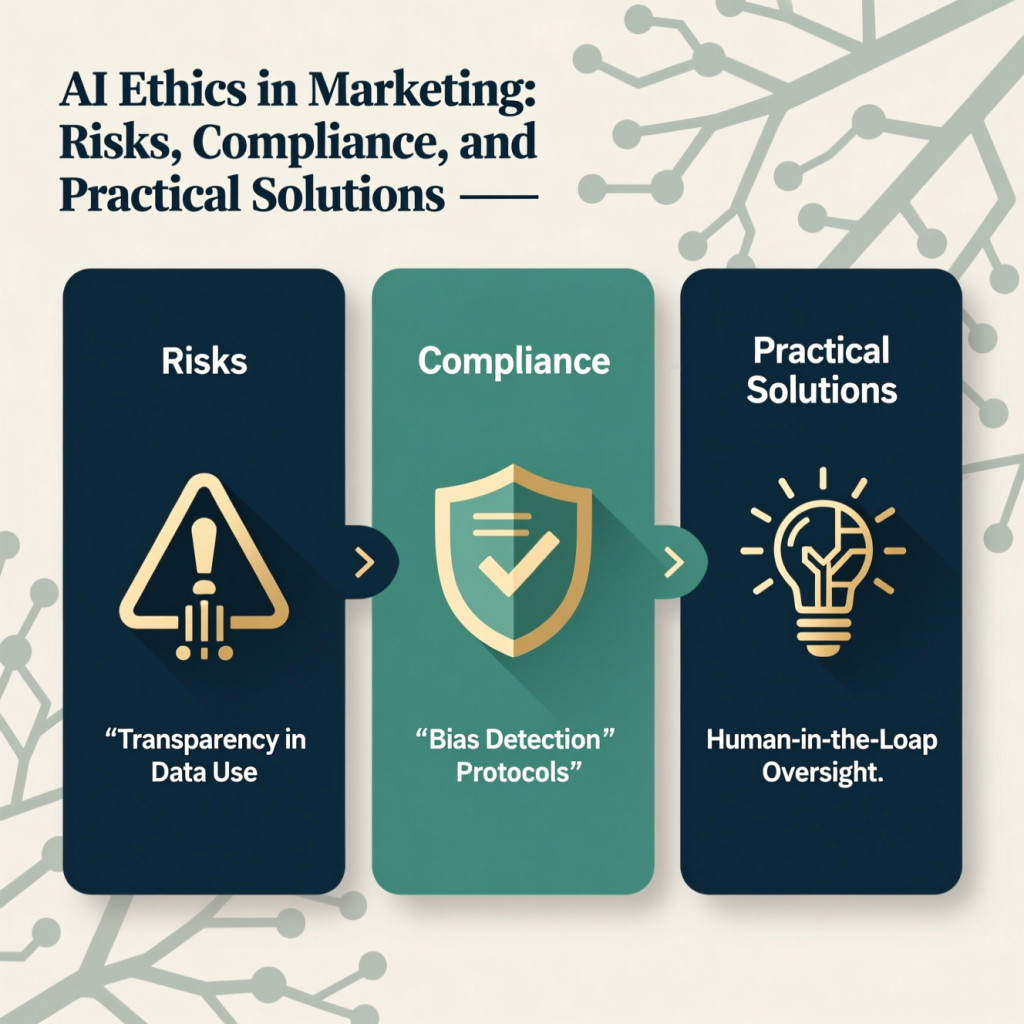
6) AI governance framework (simple but solid)
This is the part most teams skip—and regret later.
Step 1 — Create an AI Usage Policy (1 page)
Include:
- Allowed uses (drafting, ideation, variations)
- Forbidden uses (sensitive data, fake reviews, medical/legal advice)
- Data rules (what never goes into prompts)
- Disclosure approach
- Approval workflow
Step 2 — Create a “Human-in-the-loop” workflow
For blog content:
- writer drafts with AI,
- editor fact-checks,
- final reviewer validates brand + compliance.
For ads:
- AI generates variations,
- marketer checks claims + platform policy,
- compliance review for sensitive niches.
Want to apply this in ads and avoid rejections / brand risk?
➡️ AI and Ads: Optimizing Google Ads and Meta Ads
Step 3 — Maintain a prompt library
Create internal templates for:
- SEO outlines,
- ad creative angles,
- email sequences,
- compliance-safe claims.
Step 4 — Run monthly audits
Check:
- ad disapprovals and why,
- complaint rates (email + ads),
- content corrections after publishing,
- segment distribution (bias check),
- data handling process.
7) Practical checklist (copy/paste for your team)
Data & privacy
- No personal identifiers in prompts unless vendor policy allows it
- Consent captured and documented
- Data retention policy clear
- Vendor settings reviewed (no training on your data if possible)
Content accuracy
- No stats without sources
- Claims verified against product reality
- Human review completed
Fair targeting
- Segments audited monthly/quarterly
- No proxy discrimination patterns
- Guardrails defined
IP & brand
- No competitor rewriting prompts
- Asset origin documented
- Brand voice consistent
Transparency
- Disclosure policy defined (if needed)
- No fake testimonials / fake identities
Conclusion
AI ethics is not about slowing down marketing. It’s about scaling responsibly—so you can move fast without breaking trust.
Next steps in this cluster:
- Full strategy overview: AI Redefines Digital Marketing: Winning Strategies
- Content workflow + QA: AI for Content Creation
- Ads optimization + compliance: AI and Ads
- CRM personalization: Personalization at Scale
- Predictive insights: Predictive Analytics