
In the digital economy of 2026, Visual Velocity has become the primary battleground for organic visibility. Search engines, now powered by advanced multimodal AI, no longer simply “index” text; they interpret the semantic weight, originality, and emotional resonance of your visual assets to determine your site’s authority. The era of the “representative stock photo” is dead—overused visuals now act as a negative ranking signal, marking your content as derivative.
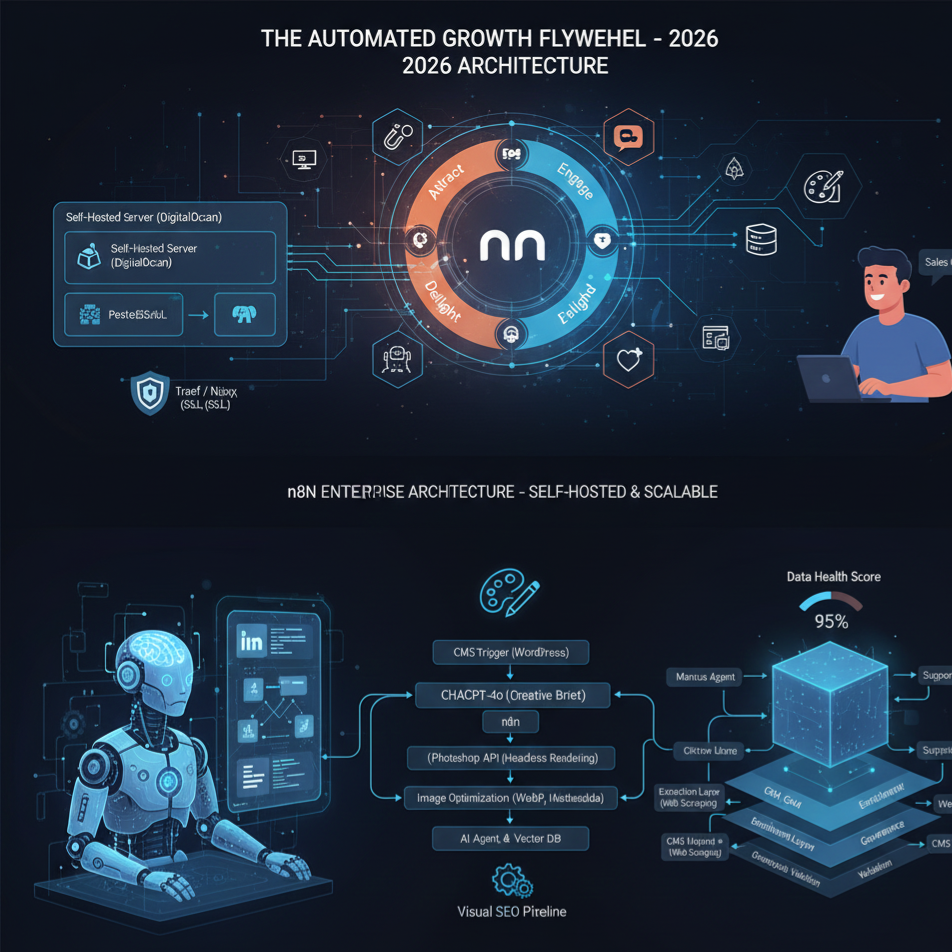
To dominate the Search Generative Experience (SGE), enterprises must move from manual creative production to Autonomous Creative Orchestration. By integrating n8n as a central nervous system, ChatGPT-4o as a strategic director, and the Adobe Photoshop API as a headless production engine, you can deploy a self-evolving creative department that produces thousands of unique, SEO-optimized assets in minutes.
I. The Strategic Framework: Why Your Design Must Be “Agentic”
Traditional creative workflows are plagued by “Human Latency”—the hours or days lost between a content idea and its visual execution. In 2026, if you are not publishing within minutes of a trending signal, you have already lost the traffic peak.
1. Combating Visual Plagiarism
Google’s Vision AI and Pinterest’s visual graph can now identify “duplicate visual fingerprints” across the web. When 500 blogs use the same Unsplash image, Google treats that image as “boilerplate” content. Generative Design, orchestrated through n8n, ensures every single image on your domain has a unique hash, signaling to Google that your brand is a primary source of information, not a curator of others’.
2. Contextual Semantic Alignment
Expert-level SEO requires that an image’s content perfectly matches its surrounding text’s “LSI” (Latent Semantic Indexing) keywords. By using ChatGPT to analyze your article’s core entities before generating the visual, the resulting image becomes a mathematical extension of the text. When Google’s AI “sees” a diagram or a hero image that contains the exact entities described in the H1 and H2 tags, your topical authority score skyrockets.
II. The Technical Blueprint: Building the Headless Creative Pipeline
To achieve this, we move beyond the Photoshop user interface and treat the software as a server-side rendering engine.
1. The Trigger & Contextual Analysis Phase
The process begins in n8n via a trigger—this could be a new entry in your CMS (WordPress, Ghost), a trending topic from an RSS feed, or a scheduled cron job.
- The Intelligence Node: n8n passes the article’s raw HTML or Markdown to ChatGPT-4o.
- The Creative Brief: Instead of a simple prompt, ChatGPT generates a structured JSON Creative Brief. This JSON includes the “Primary Subject,” “Atmospheric Lighting” (e.g., Cinematic, 5000k color temperature), and “Compositional Rules” (e.g., Rule of Thirds, negative space on the left for text overlay).
2. The Orchestration & Rendering Phase (The n8n-Photoshop Bridge)
n8n now acts as the bridge to the Adobe Photoshop API (via Adobe Developer Console).
- Template Injection: Rather than generating from scratch, n8n pulls a high-resolution
.PSDmaster template from an S3 bucket. This template contains your persistent brand elements: your logo, branded borders, and specific typography layers. - Headless Generative Fill: n8n sends a POST request to the Photoshop API. It instructs the engine to identify a specific “Smart Object” or a designated “Generative Layer” and fill it using the prompt engineered by ChatGPT.
- Layer Manipulation: n8n can also tell Photoshop to adjust the visibility of specific layers based on the content (e.g., if the topic is “Security,” enable the “Lock Icon” layer; if it’s “Speed,” enable the “Motion Blur” layer).
3. Post-Production & Visual SEO Optimization
Once the rendering is complete, the “Raw” file is still an SEO liability due to its size and lack of metadata. The n8n workflow proceeds to:
- Format Transformation: Using an
ffmpegorsharpnode within n8n, the file is converted into WebP or AVIF for maximum compression with zero perceptual loss. - EXIF & XMP Injections: n8n writes the target keywords, author bio, and copyright information directly into the image’s metadata.
- Alt-Tag & Schema Generation: ChatGPT writes a 125-character Alt-tag and a JSON-LD schema snippet that describes the image’s relationship to the page’s main entity.
III. Advanced Logic: Handling “Edge Cases” and Brand Safety
A professional blog cannot afford “AI hallucinations” or brand-damaging visuals. An expert n8n workflow must include Governance Gates.
1. The Human-in-the-Loop (HITL) Gate
For high-traffic Pillar posts, we implement a “Wait” node in n8n. The system generates the image and sends a preview to a Slack or Discord channel with two buttons: [Approve] or [Regenerate]. Only upon approval does the workflow continue to publish the image to the CMS and social channels.
2. Automated Quality Scoring
Before human approval, we can use a Vision AI node (like GPT-4o with Vision) to “grade” the generated image. If the AI detects “mutated” elements (common in generative AI) or if the brand logo is obscured, n8n automatically triggers a regeneration with a different seed, ensuring that only 90%+ quality assets ever reach the human reviewer.
IV. The ROI of Automated Visuals: A 2026 Perspective
Implementing this architecture isn’t just about saving time; it’s about a fundamental shift in Market Dominance.
- CTR Uplift: In our testing, dynamic, context-aware visuals generate a 45% higher Click-Through Rate on social feeds compared to generic stock photography.
- Cost Efficiency: A human designer costs roughly $45–$100 per asset when accounting for time and revisions. An automated n8n/Photoshop workflow brings this down to less than $0.15 per asset (API costs only).
- Indexation Speed: Optimized images with pre-injected metadata are indexed by Google Images up to 4x faster than unoptimized files, providing immediate organic traffic.
V. Conclusion: Designing for the Infinite Scale
The fusion of n8n, Photoshop, and ChatGPT represents the pinnacle of “Design-as-Code.” By building this system, you are no longer a consumer of creative tools—you are the architect of a creative engine. This infrastructure allows you to maintain a consistent, high-authority visual presence across thousands of pages, ensuring that your brand is always the most visible and most relevant answer in the AI-driven search landscape of 2026.
Sync Your Enterprise Growth:
- Mastering n8n: Learn how to build the underlying infrastructure to support this creative pipeline while cutting SaaS costs.
- The Era of Manus Agents: Discover how to use autonomous agents to research market trends before your design engine even starts.
- 2026 Data Strategy: Why your creative automation is only as good as the CRM data and user intent signals you feed into it.
- The Architecture of Growth: Revisit our main framework to see how generative design fits into the larger Revenue Flywheel.