
Marketing is usually reactive: you look at last month’s report and try to fix it.
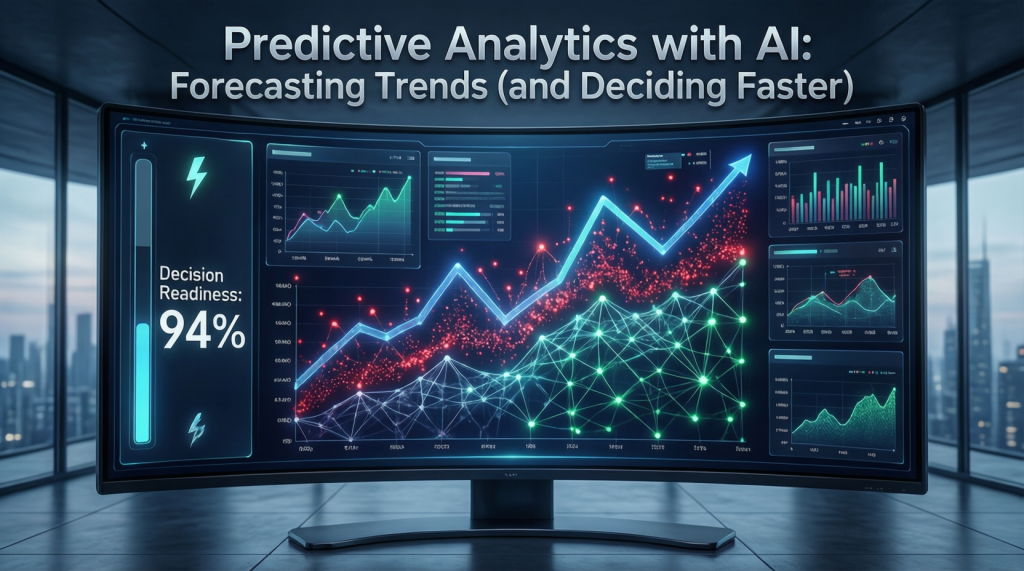
Predictive Analytics flips the script. It uses your historical data to tell you what will happen next.
It’s not magic; it’s math. And AI makes it accessible to everyone, not just data scientists.
For the global AI marketing strategy, read the pillar:
➡️ AI Redefines Digital Marketing: Winning Strategies
1) Reporting vs. Predictive: What’s the Difference?
| Reporting (Look Back) | Predictive (Look Forward) |
|---|---|
| “We lost 10% of customers last month.” | “We will lose 15% of customers next month unless we act.” |
| “This ad had a high CTR.” | “This audience will have a high LTV.” |
| Question: What happened? | Question: What will happen? |
2) The 3 Use Cases with Highest ROI
You don’t need to predict everything. Start with these three:
🛑 1. Churn Prediction (Save Revenue)
Identify customers who are about to leave before they actually do.
- Signal: Drop in login frequency + negative support ticket.
- Action: Trigger a “We miss you” offer automatically.
- Connected to CRM: ➡️ Personalization at Scale: How AI Improves CRM
📈 2. Demand Forecasting (Optimize Inventory/Content)
Know what people will want next month.
- Signal: Seasonality + current search trends.
- Action: Write content or stock products before the rush.
💰 3. Lead Scoring (Focus Sales Efforts)
Which leads will actually buy?
- Signal: Visited pricing page + downloaded case study.
- Action: Sales calls them immediately.
3) How to Start (No Data Scientist Required)
You don’t need fancy Python models. You need clean data.
Step 1: Centralize your data
Stop having data in Ads, Analytics, and Email separately. Put it in a CRM or Data Warehouse.
Step 2: Define your “Success Metric”
What are you trying to predict? (e.g., “Will they buy in 30 days?”)
Step 3: Feed the AI
Use tools like HubSpot, Salesforce Einstein, or even simple regression tools in Excel/Looker Studio. Feed it:
- Past purchases.
- Website activity.
- Email engagement.
Step 4: Act on the Score
- Score 0-30 (Low): Nurture via email.
- Score 70-100 (High): Call them or retarget with a hard offer.
4) The “Golden Rule” of Predictive Analytics
Garbage In = Garbage Out.
If your tracking is broken (e.g., you lost 40% of data due to cookie consent), your predictions will be wrong.
- ✅ Fix your tracking pixels first.
- ✅ Standardize your UTMs.
- ✅ Clean your database.
5) Connect Predictions to Ads (The Real Money Maker)
This is where it gets interesting. You can upload your Predictive Audiences (High LTV, Low Churn) directly into Google and Meta.
Instead of targeting “Interests,” you target “People who behave like my best customers.”
To learn how to target these audiences:
➡️ AI and Ads: Optimizing Google Ads and Meta Ads
Conclusion
Predictive analytics turns marketing from a “cost center” into a “revenue driver.” You stop hoping for sales and start engineering them.