
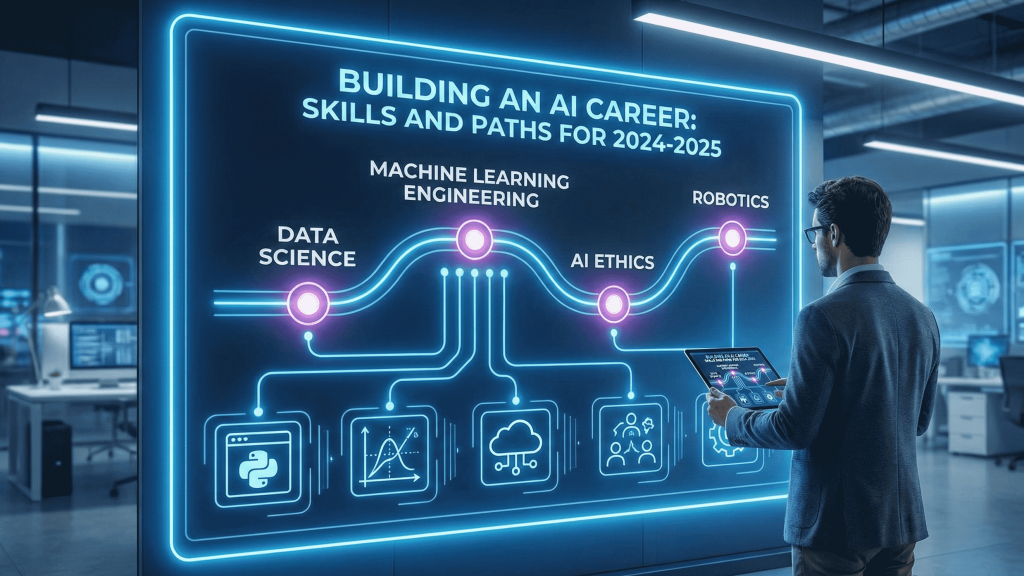
Building career — Building ai career is one of the most important topics in AI and automation in 2026. Meta Description: Explore career paths in AI, essential skills, and how to prepare yourself for a thriving AI career.
The AI revolution is creating unprecedented career opportunities. Whether you’re just starting out or looking to transition into AI, understanding the landscape and preparing yourself strategically can position you for success.
AI Career Paths
AI Engineer
Builds and maintains AI systems in production. Requires strong software engineering skills combined with machine learning knowledge. Focus on scalability, reliability, and performance.
Skills needed: Python and other languages, ML frameworks like TensorFlow, software engineering practices, cloud platforms, MLOps tools.
Typical responsibilities: Design and implement AI solutions, optimize model performance, manage data pipelines, deploy and monitor systems.
Data Scientist
Analyzes data and develops machine learning models. Requires strong statistics and math background combined with programming skills. Focus on extracting insights and building predictive models.
Skills needed: Statistics and mathematics, Python and R, ML algorithms, data visualization, communication and storytelling.
Typical responsibilities: Explore data and identify patterns, build and test models, validate results, communicate findings to stakeholders.
AI Ethics Specialist
Ensures responsible AI development and deployment. Requires understanding of ethics, technology, and business. This is an emerging role with growing demand.
Skills needed: Understanding of AI ethics frameworks, knowledge of bias and fairness, communication skills, domain expertise in relevant fields.
Typical responsibilities: Conduct ethical assessments, provide guidance on responsible practices, audit AI systems, educate organizations.
Prompt Engineer
Develops and optimizes prompts for large language models like ChatGPT. This emerging role focuses on getting the best results from AI tools.
Skills needed: Understanding of AI models, creativity and experimentation, clear communication, domain knowledge in relevant areas.
Typical responsibilities: Develop prompts for various tasks, test and optimize for quality, document best practices, train users.
AI Policy Advisor
Guides policy development and governance around AI. Requires understanding of technology, policy, and business. Works with governments, organizations, and advocacy groups.
Skills needed: Policy analysis, understanding of AI technology, communication skills, domain expertise.
Typical responsibilities: Research AI policy issues, advise on governance frameworks, engage stakeholders, contribute to standards development.
Researcher
Advances AI capabilities through novel research. Typically requires advanced degree and publications. Works in academia, research labs, or industry research groups.
Skills needed: Advanced mathematics and statistics, research methodology, domain expertise, communication skills.
Typical responsibilities: Conduct research on AI problems, publish findings, collaborate with other researchers, present at conferences.
Skills You’ll Need
Technical Skills
Machine Learning foundational knowledge of algorithms, supervised and unsupervised learning, model evaluation. Deep Learning understanding of neural networks, architectures like CNNs and RNNs. Python proficiency with libraries like TensorFlow, PyTorch, scikit-learn.
Understanding Ethics and Bias
Recognize and mitigate bias in AI systems. Understand fairness frameworks and techniques. Know how to explain AI decisions. Understand privacy and security considerations.
Business Acumen
Understand how AI solves real business problems. Know how to evaluate ROI. Understand market trends. Communicate effectively with non-technical stakeholders.
Human Skills
Creativity and problem-solving ability. Critical thinking and analytical skills. Communication and presentation ability. Teamwork and collaboration. Curiosity and willingness to learn.
How to Prepare
Start Learning
Take online courses on platforms like Coursera, Udacity, or edX. Read books and research papers. Follow AI news and developments. Join online communities and forums.
Get Hands-On Experience
Build projects using publicly available datasets. Contribute to open-source AI projects. Participate in Kaggle competitions. Work on internships or contract projects.
Build a Portfolio
GitHub repository with your projects. Blog documenting your learning and projects. Portfolio website showcasing your work. Contributions to open-source projects.
Network
Attend AI conferences and meetups. Join online communities. Connect with practitioners on LinkedIn. Participate in hackathons.
Specialize
Choose an area of interest like computer vision, NLP, reinforcement learning, or AI ethics. Develop deeper expertise in that area. Consider certifications in your specialization.
Stay Current
Follow AI researchers and influencers. Read research papers from arXiv. Attend webinars and workshops. Participate in ongoing learning.
The Future of AI Careers
AI careers are evolving rapidly. New roles are emerging. Demand far exceeds supply for qualified professionals. Salaries are competitive and growing. Remote work is common in AI roles.
The most successful AI professionals will likely be those who combine technical skills with understanding of ethics, business, and human impact. They’ll be continuous learners comfortable with change and ambiguity.
Getting Started Today
Pick one skill to focus on first. Whether it’s learning Python, understanding machine learning fundamentals, or studying AI ethics. Take your first course this week. Join an online community. Start working on a small project.
The AI field needs diverse talent with varied backgrounds and perspectives. Your unique skills, experiences, and perspectives have value. The field benefits from engineers, ethicists, entrepreneurs, artists, and more.
Conclusion
Building an AI career is achievable regardless of your starting point. The field is growing rapidly. The skills you build now will be valuable for years to come. Most importantly, the decisions you make about AI now will shape the future of the technology.
Start your learning journey today. The future of AI is being built by people like you making intentional choices to build better, more responsible AI systems.
Continue learning
← Back to Future of AI and Ethical Considerations
Next: Machine Learning Essentials