

Meta Description: Deep dive into deep learning, neural networks, and how they power modern AI applications.
Deep Learning represents one of the most powerful and transformative branches of Artificial Intelligence today. Unlike traditional Machine Learning algorithms that rely on hand-crafted features, Deep Learning systems automatically discover the representations needed for detection or classification from raw data. This revolutionary approach has powered breakthrough applications from defeating world chess champions to enabling autonomous vehicles.
If you’ve heard about ChatGPT, image recognition, voice assistants, or self-driving cars, you’re witnessing Deep Learning in action. This pillar article demystifies Deep Learning, exploring how neural networks learn from data and why they’re so effective for solving complex problems.
What Is Deep Learning?
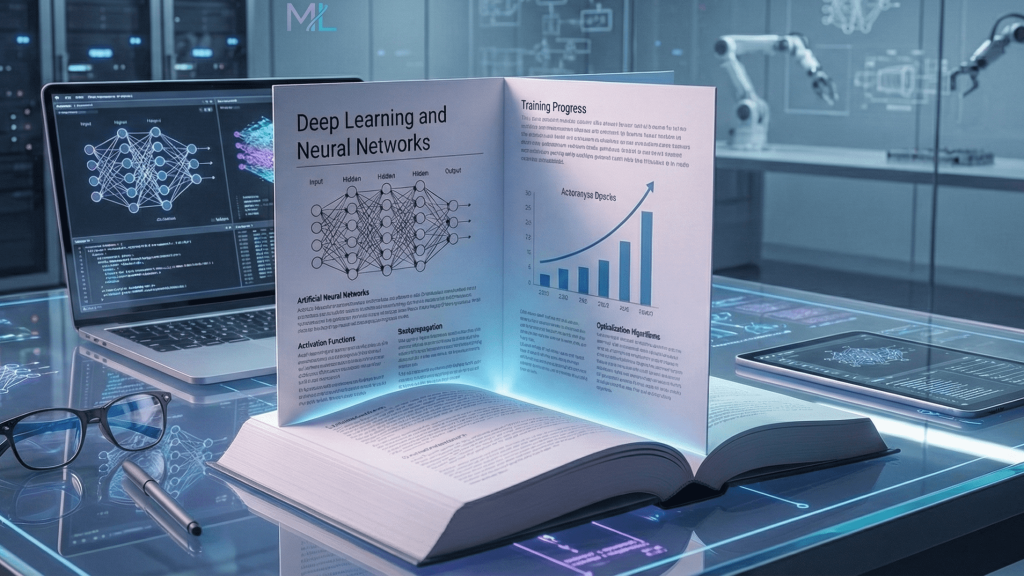
Deep Learning is a subset of Machine Learning based on artificial neural networks with multiple layers, hence “deep”. These networks mimic the structure and function of biological brains, learning hierarchical representations of data.
Why “Deep”?
The term “deep” refers to the depth of the neural network, the number of layers between input and output. Shallow networks have few layers; deep networks have many. The layered architecture allows networks to learn increasingly abstract representations of data.
For example, a deep network analyzing images might learn low-level features like edges and colors in Layer 1, mid-level features like textures and shapes in Layer 2, and high-level features like facial features or objects in Layer 3, finally outputting a classification.
Understanding Neural Networks
Neural Networks are inspired by biological brains but are mathematical abstractions. Understanding their structure is key to grasping Deep Learning.
Components of a Neural Network
Neurons or Nodes are the basic computational units. Each receives inputs, applies weights, adds a bias, and passes through an activation function.
Weights are parameters that the network learns during training. They determine how much each input contributes to the neuron’s output.
Biases are additional parameters allowing neurons to shift activation functions, increasing model flexibility.
Layers are groups of neurons organized hierarchically with Input Layer receiving raw data, Hidden Layers processing information, and Output Layer producing predictions.
Why Deep Learning Is Powerful
Hierarchical Feature Learning
Deep networks automatically learn hierarchical features, eliminating the need for manual feature engineering, often the most time-consuming part of Machine Learning.
Non-Linear Relationships
Deep networks excel at capturing complex, non-linear relationships that simple models miss.
Scalability
Deep Learning scales with data and compute. More data and processing power lead to better performance.
Conclusion
Deep Learning has revolutionized AI, enabling machines to solve previously intractable problems. While challenging to master, the rewards—breakthrough applications, innovation, and career opportunities—make the journey worthwhile. Ready to explore specific architectures? Check out our guides on Convolutional Neural Networks for image tasks or Recurrent Neural Networks for sequential data.