

Many freelancers struggle because they try to do too much at once. If you want to integrate AI into your routine without the constant stress of new updates, you need a focused, simple approach that enhances your flow rather than disrupting it.
Many freelancers I talk to tell me the same thing:
“I’d love to use AI… but I’m afraid I’ll drown in tools, settings, and constant updates.”
I get it. Two years ago, I was right there. I tried a new tool every week, attempted to automate everything at once—and ended up spending more time configuring than actually working.
Today, my relationship with AI is different. It’s simple, focused, and quiet. It doesn’t disrupt my flow—it enhances it.
Here’s the method I now use—and recommend to every independent professional I work with.
1. A Simple Method to Integrate AI Into Your Routine
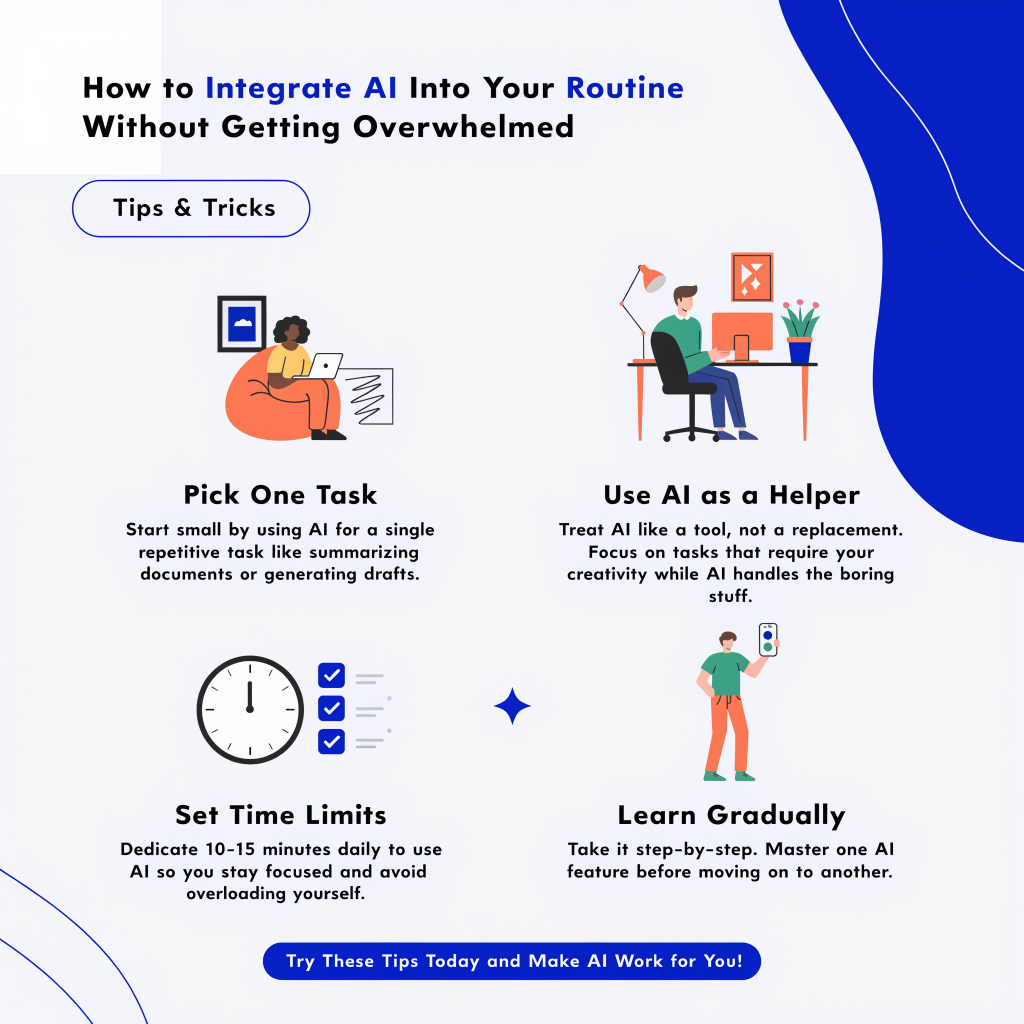
Before you even look at tools, identify one task that drains your mental energy. Not necessarily the one that takes the most time—but the one that leaves you feeling drained:
- Writing generic client emails?
- Organizing scattered notes into a clear outline?
- Planning your week without missing a deadline?
Pick just one pain point. That’s where you’ll introduce AI.
My example: For months, I wasted time turning messy notes into structured article plans. So I started using Notion AI for that one task only. Nothing else. For three weeks, I didn’t touch any other AI tool.
2. Test It for 10 Days—No More
Don’t fall into the trap of “I’ll try it someday.” Set a short trial: 10 days.
Each day, use the tool once, on your chosen task. Ask yourself:
- Did this save me time?
- Was the output usable as-is?
- Did I actually want to use it again?
If you answer “yes” to two of these, keep the tool. If not, drop it—no guilt.
AI isn’t an obligation. It’s a lever. And if a lever isn’t helping, you let it go.
3. Attach It to an Existing Habit
The biggest mistake? Creating a brand-new habit around AI (“I need to remember to open Perplexity every morning”).
Instead, embed it into a routine you already have:
- After checking email → ask your AI assistant to flag priorities.
- Before writing a blog post → run a quick research query in Perplexity.
- At the end of the day → let ClickUp summarize your next actions.
AI shouldn’t add a step. It should replace part of a step you’re already doing.
4. Limit Yourself to Three Tools Max
In 2026, it’s tempting to try every new AI that launches. But real productivity comes from mastery, not quantity.
I stick to three AI tools max:
- One for organization (Notion),
- One for research and writing (Perplexity),
- One for project management (ClickUp).
Everything else is noise. If a new tool shows up, I only add it if I remove an old one.
5. Take an AI-Free Day Once a Month
Yes, you read that right. Once a month, I force myself to work a full day without any AI.
Why? To check whether I’ve become so dependent on a tool that I’ve lost touch with my own judgment. AI should amplify your intelligence—not replace it.
And often, that “analog” day reminds me what I love most about my work: raw thinking, unfiltered creativity, and human connection.
In Short
Integrating AI into your routine isn’t a tech race. It’s an act of personal clarity: knowing what slows you down, choosing a simple ally, and letting it handle the grunt work.
The goal isn’t to become an AI expert.
It’s to reclaim time for what you do best: think, create, and move forward.