
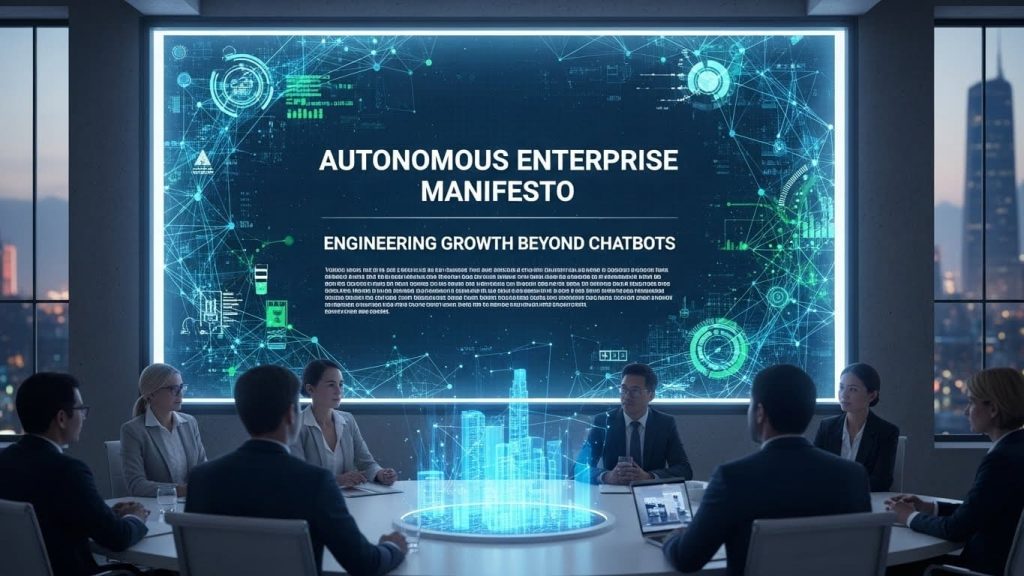
Autonomous enterprise manifesto is one of the most important topics in AI and automation in 2026. Look, I’ll be blunt. MLook, I’ll be blunt. Most business owners are stuck in the “Chat” loop. They treat AI like a toy—a parlor trick that writes emails or summarizes meetings. But the winners in 2026 are treating it like an employee. If you aren’t thinking about how to pipe these models into your CRM or your Sales Funnel, you’re just playing with a glorified typewriter.
The era of manual business administration is dead. We are now entering the age of autonomous business systems, where the goal isn’t just to “work faster” but to build a company that thinks, reacts, and scales without constant human intervention. This isn’t about productivity hacks; it’s about architectural dominance. If your company still relies on a human to move data from point A to point B, you have a bottleneck that no amount of hiring will fix. To compete, you must move beyond the interface and start building the infrastructure.ost business owners are stuck in the “Chat” loop. They treat AI like a toy—a parlor trick that writes emails or
The end of manual data entry: why your CRM is currently a graveyard
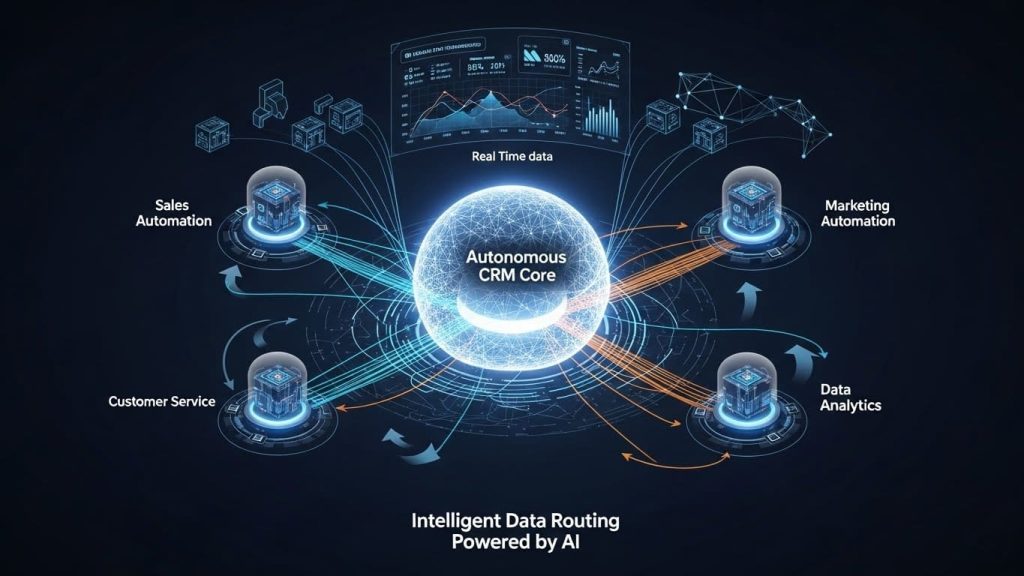
Your CRM should be the nervous system of your company, but for most, it is just a digital filing cabinet where leads go to die. Every minute your sales rep spends typing notes or updating a status is a minute they aren’t closing deals. This manual friction is a tax on your growth.
The transition to a high-performance firm requires turning that database into a CRM Logic Engine. By piping models directly into your CRM, you create a system that understands the context of every interaction. It doesn’t just store a phone number; it analyzes the sentiment of a lead, scores their intent, and routes them to the right person in milliseconds.
We are talking about building a layer of intelligence that maintains its own hygiene, purging dead data and enriching new profiles automatically. As we’ve seen in our recent Autonomous AI Agent Workflow analysis, when your CRM starts making decisions instead of just taking notes, you’ve stopped playing and started integrating.
Frictionless conversion: the mechanics of the autonomous funnel
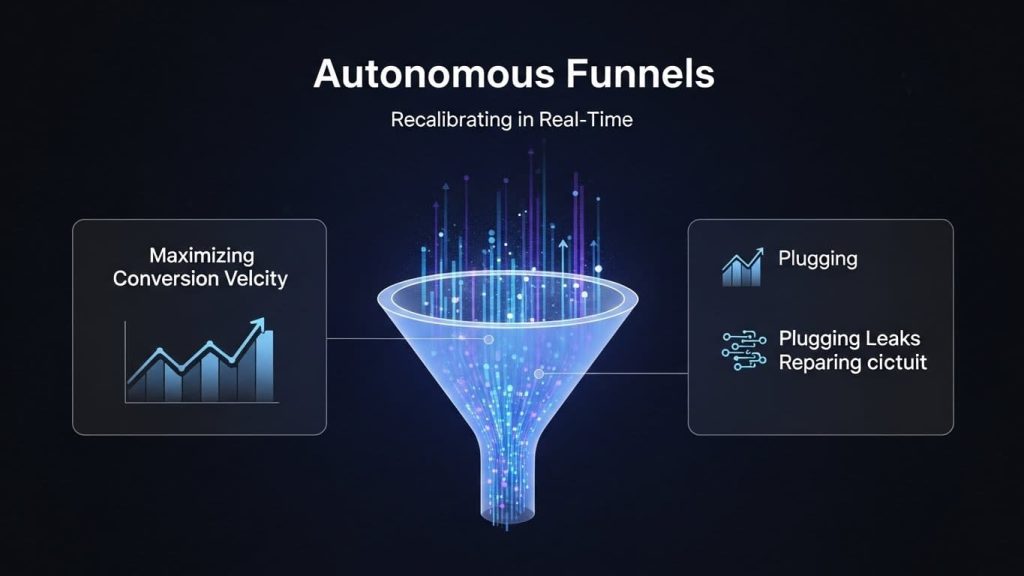
A traditional sales funnel is a leaky bucket. You pour expensive traffic in the top and hope enough people click enough buttons to reach the bottom. But humans are inconsistent. They miss follow-ups, they forget to personalize, and they sleep. An autonomous funnel never sleeps. It is a resilient, Self-Healing Sales Funnel designed to detect friction and fix it in real-time.
If a prospect stalls at the pricing page, the system doesn’t wait for a weekly report to notice. It triggers a logic branch to address the specific hesitation. By integrating your sales architecture with your backend operations, the funnel becomes a dynamic organism that adjusts its messaging based on the individual’s behavior. This level of systemization ensures that your customer acquisition cost stays low while your conversion optimization velocity skyrockets.
You aren’t just selling; you are engineering an inevitable revenue flow. This architecture allows you to scale volume without doubling your headcount, effectively turning your front-end into a permanent revenue capture machine that gets smarter with every lead it processes.
Beyond the front office: automating the backbone of your business

Fragile operations are a luxury you can no longer afford. While most focus on the “sexy” side of marketing, the real winners are building Autonomous Supply Chain Systems that synchronize physical movement with digital demand. If your warehouse isn’t talking to your CRM in real-time, you aren’t running an integrated business—you’re running a series of disconnected islands.
By treating your logistics as a neural network, you remove the “guesswork” that leads to overstocking or stockouts. Modern infrastructure allows for Predictive Inventory Forecasting that adjusts procurement orders based on global market signals before a shortage even occurs. This is how you protect your margins when the market gets volatile.
When your back-office operations are piped into your broader Autonomous Business Systems, the system handles the heavy lifting of fulfillment and vendor coordination. This ensures that as your sales team closes deals, the physical reality of your business scales instantly to meet the promise, turning your operations from a bottleneck into a competitive weapon.
Retention by design: engineering the customer lifecycle
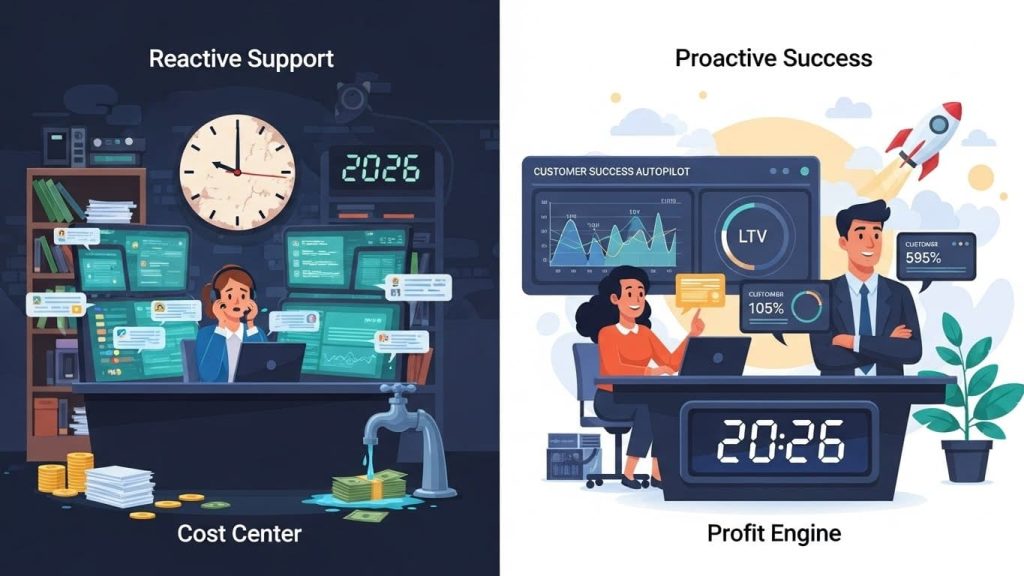
Reactive support is a cost center; proactive success is a profit engine. In 2026, if you wait for a customer to open a support ticket, you’ve already lost the battle against churn. The secret to high LTV (Lifetime Value) is implementing a Customer Success Autopilot that monitors user behavior in real-time.
By integrating your support stack into your broader Autonomous Business Systems, you can detect “silent churn” signals—like a drop in login frequency or unconfigured features—before they turn into cancellations. Your system acts as a persistent concierge, triggering automated onboarding steps or personalized technical nudges exactly when the user needs them.
This level of integration ensures that your human success managers aren’t bogged down by repetitive queries. Instead, they only step in for high-level strategic expansion, while the system handles the day-to-day retention. When your product supports itself through intelligent logic, your growth becomes truly sustainable.
Real-time capital: the end of month-end closing

Waiting thirty days for a P&L statement is a relic of the past. In a high-velocity market, delayed financial reporting is a recipe for disaster. You need real-time transparency into your cash flow, which only Financial Operations Automation can provide.
By piping bank feeds and payment gateways directly into your ledger with automated verification, you eliminate the need for manual reconciliation. The system matches invoices to payments instantly, flagging only the discrepancies for human review. This frees your finance department from tedious data entry, allowing them to focus on high-level capital allocation and strategic reinvestment.
As we covered in our deep dive on FinOps Automation Systems, this isn’t just about speed; it’s about accuracy and control. When every dollar is tracked and verified by a system loop, your leadership team gains the confidence to make aggressive moves with surgical precision, leveraging autonomous business systems to optimize profit margins that were previously hidden in spreadsheets.
Scaling the team: why your HR department needs an engine
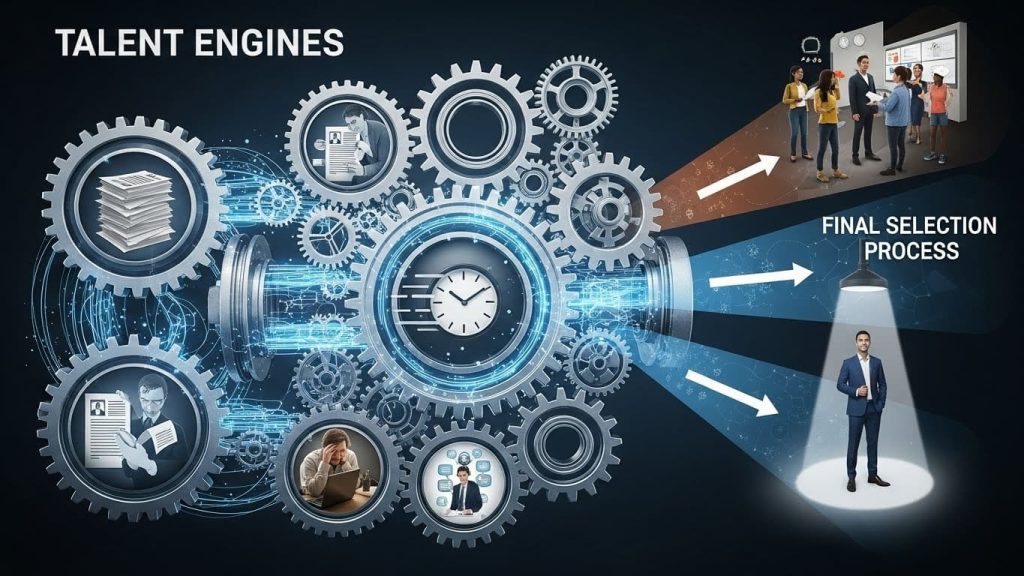
The final bottleneck of any scaling company isn’t capital; it’s the speed of its hiring. If your HR team is still manually reading every resume that hits your inbox, you’ve already lost the talent war. Elite performers are off the market in days, and your manual process is too slow to catch them. You need to transition to Automated Talent Acquisition Systems that function as a high-speed filtration engine.
Leveraging autonomous business systems in your recruitment allows you to score, filter, and schedule candidates without a single human click. By piping candidate data into your logic engines, the system can rank applicants against your specific technical requirements and cultural benchmarks instantly. This ensures that your hiring managers are only spending time on the top 1% of talent.
As we’ve explored in our guide to HR Systems Integration, an automated engine also ensures a seamless candidate experience. Constant communication and instant feedback loops build a professional brand that attracts top-tier hires. When your talent acquisition is a predictable utility rather than a frantic search, your growth capacity becomes limitless.
The blueprint for the unstoppable enterprise
The message is blunt because the stakes are high. Treating AI like a “chat toy” instead of an integrated employee is a guaranteed way to be left behind by 2026. The autonomous enterprise isn’t a futuristic concept; it is the current standard for any company serious about sustainable growth.
We’ve covered the core pillars: transforming your CRM into a CRM Logic Engine, building Self-Healing Sales Funnels, orchestrating Autonomous Supply Chain Systems, designing Customer Success Autopilot workflows, deploying Financial Operations Automation, and engineering Automated Talent Acquisition Systems. Each of these components, when integrated, forms a resilient, intelligent, and self-optimizing business.
Your competitors are not waiting. They are building. They are piping. They are integrating. Stop chatting about what AI could do. Start building the systems that will define your market leadership. The future belongs to the automated, to the integrated, and to those who understand that in 2026, the real work is done by the architecture, not just the people.