

Engineering Autonomous AI Agent Workflows for Backend Operations
Look, the world has enough prompt engineers. What we need are system architects. If you’re still copy-pasting text into a browser window, you’re missing the point of the current revolution. The real power lies in Autonomous AI Agent Workflows—systems that don’t wait for you to click “send.” These agents are designed to live inside your backend, monitoring data triggers and executing multi-step tasks while you sleep. We’re moving from human-in-the-loop to human-on-the-loop, and the efficiency gains are staggering.
The architecture of a “No-Prompt” system
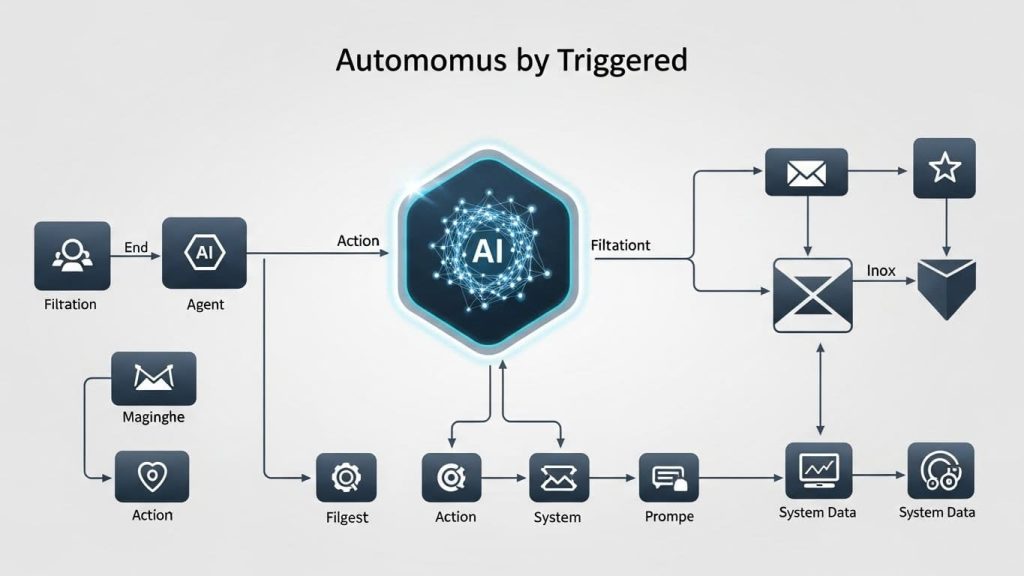
The ultimate goal of any tech-forward firm is to eliminate the interface entirely. In an autonomous workflow, the agent doesn’t need a prompt; it needs a trigger. This could be a new row in a database, an incoming API call, or a specific change in market data. Once the trigger is activated, the agent follows a pre-defined logic branch to execute its task.
This isn’t just about speed; it’s about building a CRM Logic Engine that operates with surgical precision. When you pipe these models directly into your systems, you’re not asking the AI for help; you’re assigning it a role. This is the foundation of the autonomous business systems we discussed in our Autonomous Enterprise Manifesto.
Agent Autonomy and Multi-Step Execution
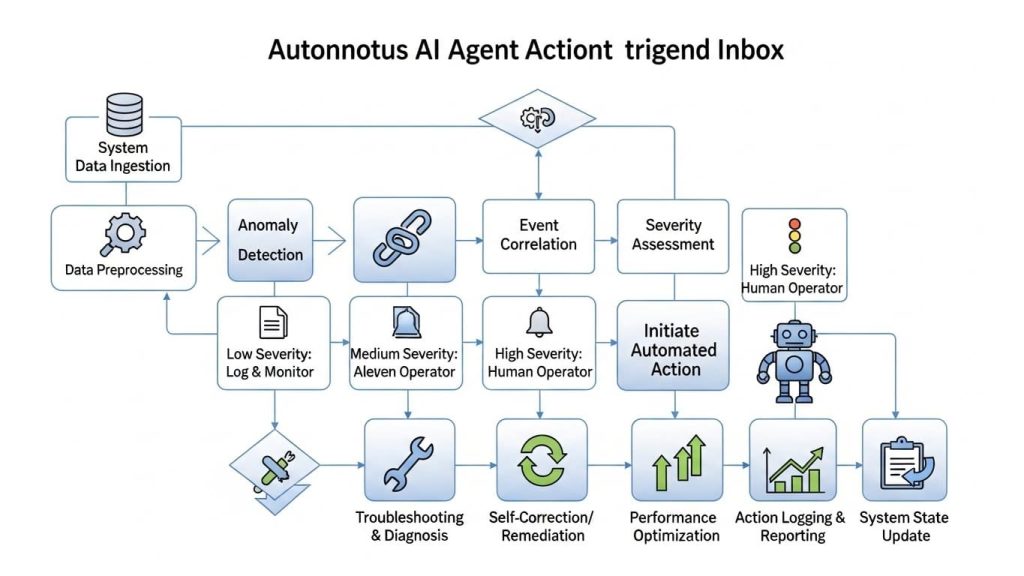
Standard automation moves in a straight line: if A happens, do B. But Autonomous AI Agent Workflows are non-linear. They can evaluate the quality of an output and decide to re-run a step or branch off into a different process entirely. This is what separates a basic script from an “employee” grade system. For example, if an agent is tasked with researching a lead, it doesn’t just scrape a website; it cross-references data, validates emails, and then decides whether that lead belongs in your high-priority Self-Healing Sales Funnel.
By leveraging multi-step execution, you reduce the need for manual oversight. You can build loops where one agent generates a draft, a second “critic” agent reviews it against your brand guidelines, and a third agent handles the distribution. This chain of command happens in the background, ensuring that your Autonomous Business Systems are always moving toward a result without hitting a human bottleneck.
The ROI of “No-Touch” Backend Operations
The real win of these workflows isn’t just “saving time”—it’s the massive increase in Closing Rates and operational velocity. When you implement this playbook, your team stops acting as the “filter” and starts acting as the “architect.” By the time a human interacts with a process, the AI agent has already done the 90% of the grunt work—scoring, cleaning, and preparing the data.
As we’ve noted in our Autonomous Enterprise Manifesto, the tools are ready. The question is: are you ready to stop being the manual bridge between your apps? By piping these agents into your Financial Operations Automation, you ensure that every part of your business is working in sync, 24/7, without the high cost of a massive backend team.
Conclusion
Stop thinking about AI as a chat box and start thinking about it as the engine of your infrastructure. Autonomous agent workflows are the secret to scaling in 2026 without losing your mind—or your margin.