
In today’s fast-paced, always-on business environment, customer expectations have never been higher. A simple chatbot that answers basic FAQs is no longer enough; customers demand proactive, personalized, and immediate resolution to complex issues. This is where the power of the autonomous customer service bot—an evolution of the traditional chatbot—shines.
Unlike their predecessors, autonomous AI agents are designed to resolve issues end-to-end, acting as tireless, 24/7 digital employees. They don’t just react to problems; they are programmed to anticipate and address them before a customer even initiates contact.
The Limitation of Traditional Chatbots
Traditional customer service bots are essentially decision trees. They follow a rigid script: “Did you mean A, B, or C?” If the customer deviates from the expected path or the issue requires interaction with a back-end system (like issuing a refund or updating an order), the chatbot immediately fails and hands off to a human. This creates friction and frustrates the customer.
The Proactive Power of Autonomous Agents
Autonomous customer service agents are built upon sophisticated AI Agent Automation frameworks (as discussed in detail in our The Rise of Autonomous AI Agents: Transforming Business Workflows and Productivity. Their core strength lies in their ability to reason, plan, and utilize tools autonomously.
Here are three ways these agents deliver proactive, high-impact customer service:
1. Preemptive Issue Resolution
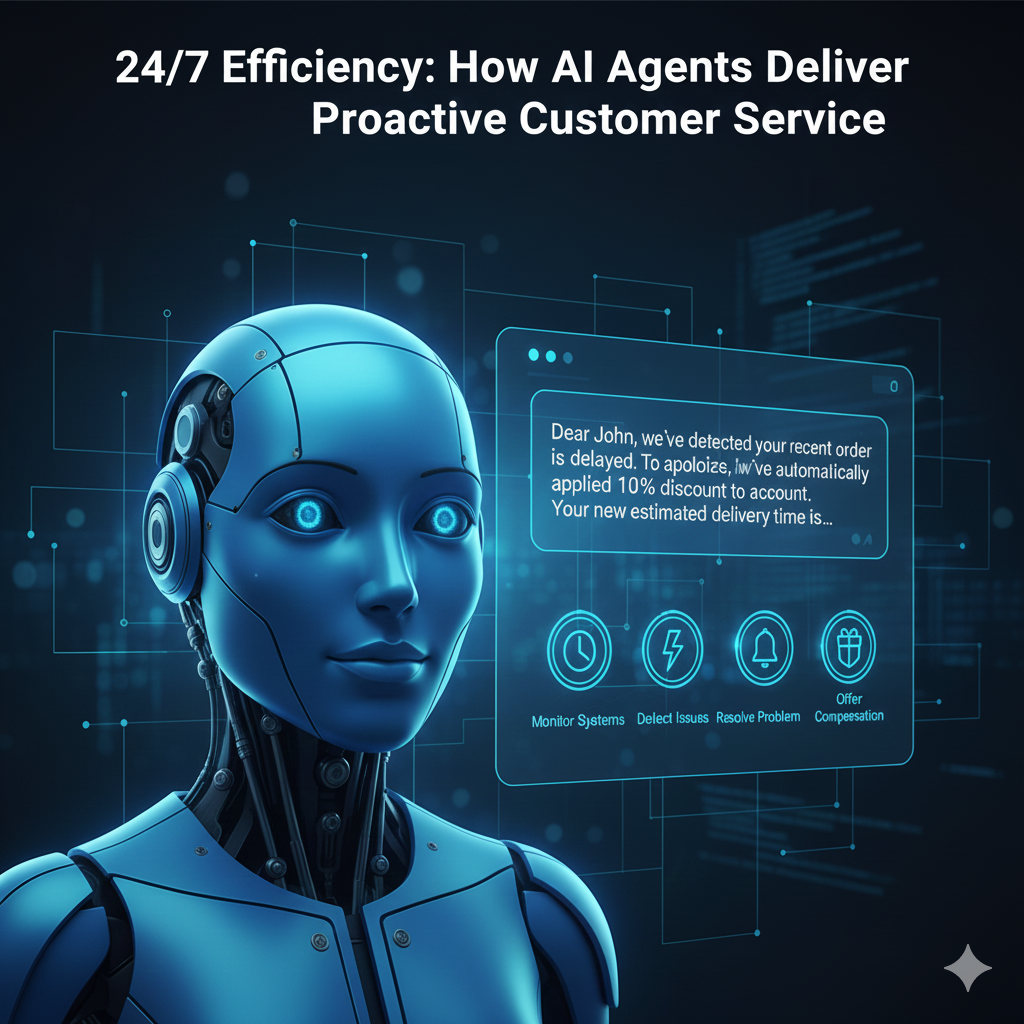
An autonomous agent doesn’t wait for a customer to complain about a late delivery. Instead, it continuously monitors data streams—such as logistics systems and order tracking—and performs background checks.
Example Scenario:
- The agent detects a shipping delay impacting a Tier 1 customer’s order.
- Action: The agent autonomously creates a high-priority ticket, notifies the customer via email/SMS with the updated delivery time, and immediately applies a 10% discount voucher as compensation—all without a human intervening.
2. Multi-System Integration
Complex customer issues often require navigating multiple business systems: the CRM, the billing platform, and the inventory database.
- Traditional bots fail here. Autonomous agents, however, are integrated with these back-end APIs (their “tools”). When a customer asks for a refund, the agent can:
- Verify the purchase history in the CRM.
- Check the return status in the inventory system.
- Process the refund in the billing platform.
- Send a confirmation email.
This multi-step, cross-system orchestration allows the bot to handle nearly 80% of routine and moderately complex inquiries entirely on its own.
3. Hyper-Personalized Conversations
The agent’s ability to maintain “memory” and context allows for truly personalized interactions. If a customer is a high-value repeat buyer, the bot knows to prioritize their support request and adopt a premium, white-glove tone. If they are a first-time user struggling with setup, the bot can adjust its language to be simpler and provide links to specific tutorials tailored to their past purchases.
By providing this level of sophisticated, proactive, and personalized support, autonomous customer service bots do more than just save costs; they dramatically increase customer satisfaction, loyalty, and ultimately, lifetime value. For any growing business targeting the US market, this shift from reactive support to proactive agentic customer service is essential.