
What Are the Best AI Agent Frameworks in 2026?
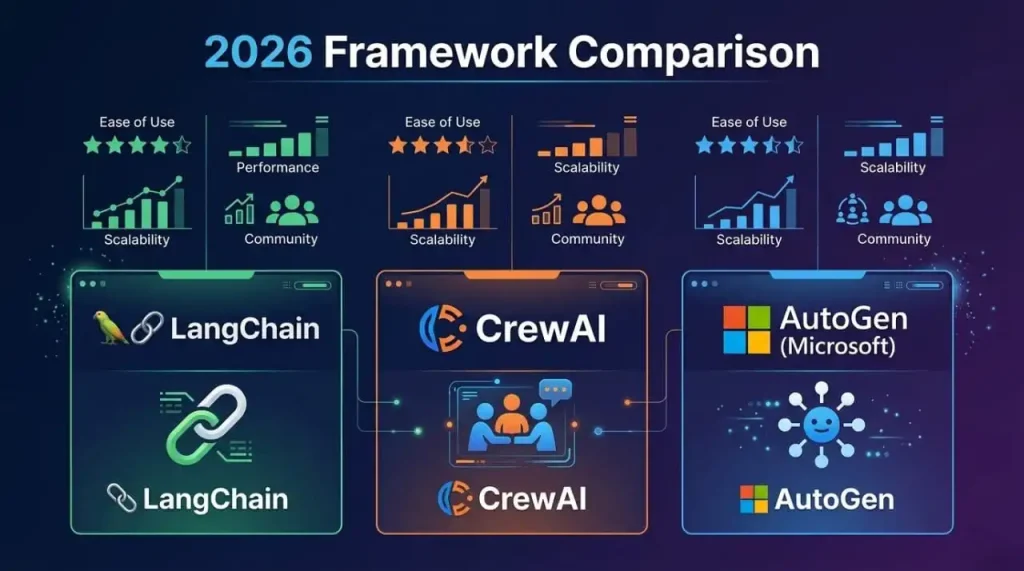
Langchain vs crewai vs autogen — Best AI agent frameworks in 2026: LangChain, CrewAI, and AutoGen are the three dominant frameworks for building autonomous AI agents. LangChain is the most mature and flexible. CrewAI is the easiest for multi-agent role-based systems. AutoGen (Microsoft) excels at conversational multi-agent tasks. Choosing the right one depends on your use case, team skill level, and how much flexibility you need.
AI Agent Frameworks 2026: Feature Comparison
| Feature | LangChain | CrewAI | AutoGen |
|---|---|---|---|
| Creator | LangChain Inc. | João Moura (open-source) | Microsoft Research |
| GitHub stars | 90k+ | 25k+ | 32k+ |
| Language | Python + JavaScript | Python | Python |
| Multi-agent support | Yes (LangGraph) | Yes (native) | Yes (native) |
| Learning curve | Steep | Moderate | Moderate |
| LLM support | All major LLMs | All major LLMs | All major LLMs |
| RAG support | Excellent | Good | Good |
| Tool/function calling | Excellent | Good | Excellent |
| Human-in-the-loop | Yes (LangGraph) | Yes | Yes (native) |
| Observability | LangSmith (paid) | Basic logging | AutoGen Studio |
| Best for | Complex pipelines, RAG, enterprise | Role-based multi-agent teams | Conversational agents, research |
| License | MIT | MIT | MIT (CC-BY-NC for some) |
LangChain: The Swiss Army Knife
LangChain is the most battle-tested framework with the largest ecosystem. Its strength is flexibility — you can chain together any combination of LLMs, tools, retrievers, and memory systems. LangGraph (LangChain’s graph-based orchestration layer) is particularly powerful for stateful, multi-step agent workflows with conditional branching. LangChain has connectors for 100+ tools and integrates with every major vector database. The downside: its API has changed significantly across versions, and the learning curve is steep for beginners.
Best for: Enterprise RAG applications, complex multi-step pipelines, teams with Python experience who need maximum flexibility.
CrewAI: Multi-Agent Teams Made Simple
CrewAI’s abstraction model is elegant: you define Agents (each with a role, goal, and backstory), Tasks (what each agent does), and a Crew (how agents collaborate). This makes it the fastest framework for building teams of specialized agents — a researcher agent, a writer agent, a reviewer agent — that work in sequence or in parallel. CrewAI exploded in popularity in 2025-2026 because it makes multi-agent systems accessible to developers who aren’t AI experts.
Best for: Content creation pipelines, research + synthesis workflows, any use case where different agents have distinct specialized roles.
AutoGen: Conversational Multi-Agent Collaboration
Microsoft’s AutoGen takes a different approach: agents communicate with each other through natural language conversations. You define agents (including human-proxy agents), and AutoGen orchestrates their dialogue until the task is complete. It’s particularly strong for code generation tasks — an AssistantAgent writes code, an ExecutorAgent runs it, and they iterate until the output is correct. AutoGen Studio provides a no-code UI for building and testing agent systems.
Best for: Code generation, scientific research automation, tasks that benefit from iterative agent dialogue, Microsoft Azure environments.
When to Use Each Framework
| Use case | Best framework | Why |
|---|---|---|
| Build a RAG chatbot over documents | LangChain | Best retrieval + memory ecosystem |
| Content research + writing pipeline | CrewAI | Researcher + Writer + Editor agents |
| Auto-generate and test code | AutoGen | Native code execution + iteration |
| Complex stateful workflow (if/else, loops) | LangGraph | Graph-based state machine |
| Quick prototype in under 1 hour | CrewAI | Simplest API, best docs |
| Enterprise with observability needs | LangChain + LangSmith | Production monitoring built-in |
| Microsoft Azure deployment | AutoGen | Native Azure OpenAI integration |
Getting Started: CrewAI in 5 Minutes
CrewAI is the fastest framework to get a working agent system running:
pip install crewai crewai-tools

from crewai import Agent, Task, Crew
from crewai_tools import SerperDevTool

researcher = Agent(
    role="AI Research Specialist",
    goal="Find the latest developments in AI automation",
    backstory="Expert researcher with 10 years in AI",
    tools=[SerperDevTool()],
    verbose=True
)

task = Task(
    description="Research the top 5 AI automation tools in 2026",
    expected_output="A structured report with tool names, features, and pricing",
    agent=researcher
)

crew = Crew(agents=[researcher], tasks=[task])
result = crew.kickoff()
The Emerging Landscape: What’s Coming in Late 2026
The agent framework space is consolidating fast. LangChain is investing heavily in LangGraph for production deployments. CrewAI released CrewAI Enterprise with monitoring and deployment tools. AutoGen 0.4 introduced a complete rewrite with async-first architecture. New entrants like LlamaIndex Workflows and Pydantic AI are gaining traction. The trend: frameworks are adding more structure, observability, and production tooling to move from prototype to deployment.
FAQ — AI Agent Frameworks 2026
Which AI agent framework is easiest to learn?
CrewAI — its role-based abstraction (Agent, Task, Crew) is intuitive and the documentation is excellent for beginners.
Is LangChain still worth learning in 2026?
Yes. Despite a steeper learning curve, LangChain + LangGraph are the standard for production AI applications. The ecosystem is unmatched.
Can I use these frameworks with Claude or Gemini?
Yes — all three frameworks (LangChain, CrewAI, AutoGen) support Claude 3.5/3.7, Gemini 2.5 Pro, GPT-4o, and most open-source LLMs via their API.
Is AutoGen only for Microsoft/Azure?
No — AutoGen works with any LLM API including OpenAI, Anthropic, and local models. Azure integration is available but not required.
Should I use LangChain or CrewAI for a content agency?
CrewAI for most content workflows. Its multi-agent role system (researcher, writer, editor, SEO specialist) maps perfectly to content production pipelines.