
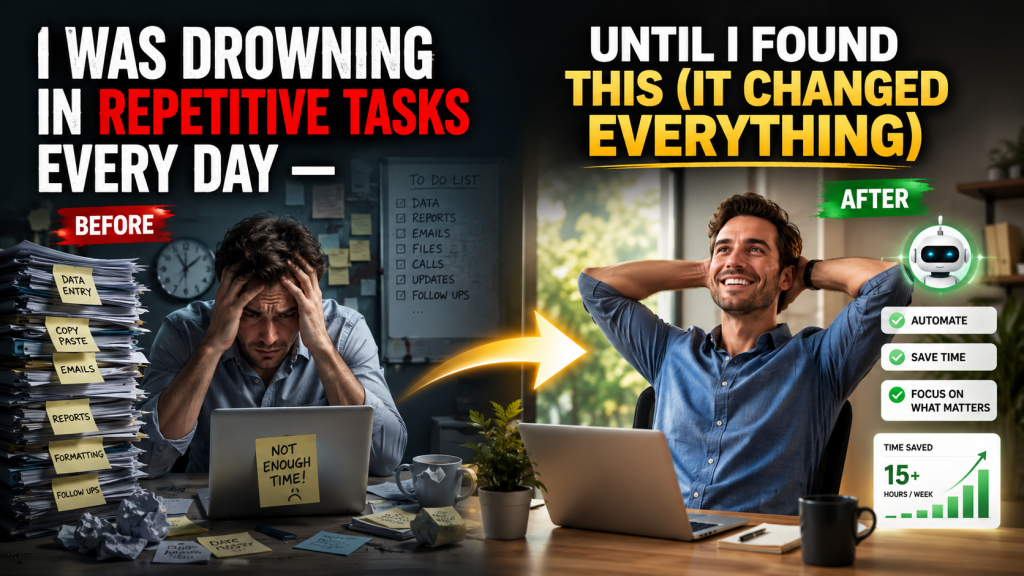
I Was Drowning in Repetitive Tasks Every Day — Until I Found This (It Changed Everything)
This is my honest story about Make automation — and how it gave me back my mornings. It started on a Tuesday six months ago.
It was 11:47 AM. I was still in my pajamas. My coffee was cold. I hadn’t eaten. And I was doing the same thing I’d been doing every single morning for the past 14 months: copy-pasting data from one spreadsheet into another.

New lead comes in from the website → I open my CRM → I manually type in the name, email, phone number, company → I open Gmail → I write the same welcome email I’ve written 400 times → I open Slack → I paste the lead details to notify my team → I update the tracking spreadsheet.
Every. Single. Lead. By hand.
That Tuesday morning I calculated it: this process alone was eating 2 hours and 40 minutes of my day. Every day. That’s 800+ hours per year spent doing something a 10-year-old could do with a pen and paper.
And that wasn’t even the only repetitive task I was doing manually. There was also: scheduling social media posts, generating weekly reports, sending invoice reminders, updating client folders, cross-posting blog articles…
My business was growing. But I was the bottleneck. And I was exhausted.
I Tried Everything. Nothing Worked.
I’m not someone who gives up easily. So I tried everything I could think of.
I hired a virtual assistant. $800/month. She was great — but she worked 4 hours a day, made occasional mistakes on data entry, needed daily briefings, and took vacations. The tasks still needed managing.
I tried Zapier. Built a few basic automations. They worked for simple 2-step tasks. But anything more complex — conditional logic, multi-step workflows, data transformation — and I was hitting walls every 20 minutes. And the pricing jumped fast: I hit the free limit in week one, then the $19/month limit two weeks later.
I tried building my own scripts. I am not a developer. This was a disaster I will not describe in detail.
For 14 months, I accepted that this was just the cost of running a business. Some things can’t be automated. You just have to do them.
I was wrong.
The Conversation That Changed Everything
In December, I was on a call with a friend who runs a 7-figure e-commerce business almost entirely by himself. I mentioned my task overload problem. He laughed — not unkindly.
“Marcus, how are you not using Make yet?”
I’d heard of Make.com (formerly Integromat) but always assumed it was for technical people. Developers. People who knew what APIs were.
“I built my entire order fulfillment system on Make in a weekend,” he said. “I have zero coding background. I haven’t touched it in 3 months. It just runs.”
That night, I created a free account. I watched one tutorial. And at 1 AM I had my first real automation running — the lead-to-CRM-to-email-to-Slack flow that had been eating 2+ hours of my morning. Running. Automatically. In 8 seconds instead of 15 minutes.
I sat in front of my screen and didn’t move for a full minute.
“Is this really all it took?”
What Make.com Actually Is — and Why It’s Different
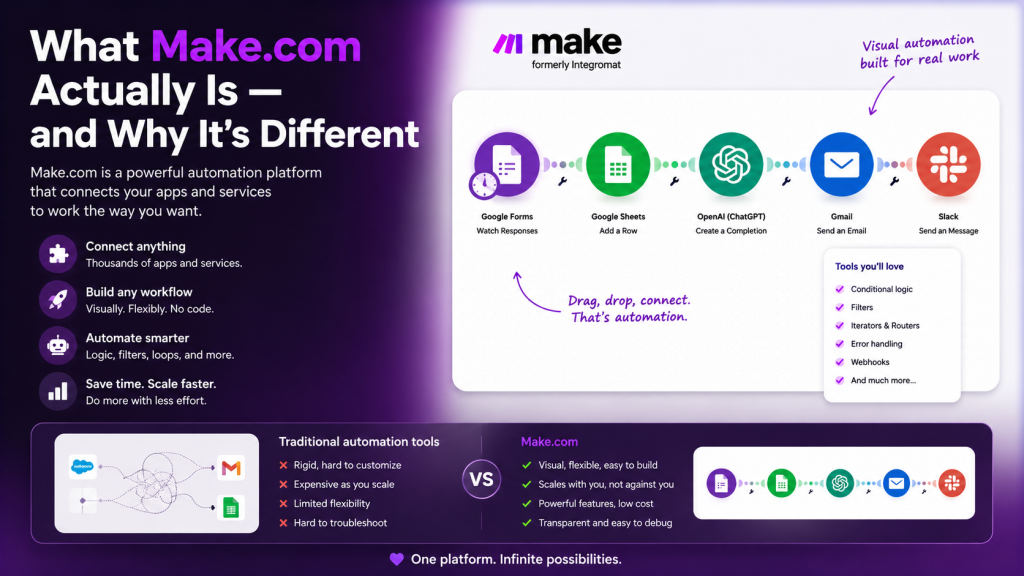
Make.com is a visual automation platform. You connect apps — Gmail, Google Sheets, your CRM, Slack, WordPress, Stripe, whatever you use — and you build workflows by dragging and dropping. No code. No developers. No technical knowledge required. For more context on the best AI automation tools available in 2026, see our full guide.
But here’s what makes it different from every other tool I tried: Make handles complexity.
Most automation tools work like a light switch: if A happens, do B. Make works like a full circuit board. You can say: if A happens, and B is true, and C hasn’t happened in the last 24 hours, then do D, then wait 2 hours, then check E, and if E is positive do F but if E is negative notify me on Slack and log the error in this spreadsheet.
That’s a real workflow I built. It took me 45 minutes. It now runs every day without me touching it.
Make connects to over 1,700 apps — if you use it for work, Make almost certainly connects to it. And unlike other tools, the pricing is based on “operations” (steps executed) rather than the number of Zaps or tasks, which means complex workflows cost the same as simple ones.
Make Automation in Action: The First 30 Days
I want to be specific, because I know “this tool will save you time!” is something every piece of software marketing says. So here is exactly what I built in my first 30 days with Make — and exactly how much time each automation saves me.
Automation #1: Lead capture → CRM → Welcome email → Slack alert
New lead fills out my contact form → automatically added to HubSpot with all fields → personalized welcome email sent from Gmail within 60 seconds → Slack notification sent to my team channel with lead details and score.
Time saved: 2h40/day → now 0 minutes.
Automation #2: Blog post → Social media cross-posting
I publish a new article on WordPress → Make automatically creates adapted versions for LinkedIn, Twitter/X, and Facebook → schedules them at optimal posting times → logs the publication in my content calendar Google Sheet.
Time saved: 45 minutes per article.
Automation #3: Weekly performance report
Every Monday at 8 AM, Make pulls data from Google Analytics, my CRM, and Stripe → compiles a formatted report → sends it to my inbox and Slack → updates a master dashboard in Google Sheets. What used to take me 90 minutes is now a PDF waiting in my inbox when I wake up.
Time saved: 90 minutes every Monday.
Automation #4: Invoice → follow-up → payment tracking
Invoice sent via Stripe → if unpaid after 7 days, automated polite reminder goes out → if still unpaid at 14 days, I get a Slack alert and a task is created in my project management tool. My accounts receivable went from 34 days average to 11 days.
Revenue impact: +23% faster cash flow.
Automation #5: New client onboarding
Client signs contract → Make creates their folder in Google Drive → sends them the onboarding questionnaire → adds them to my project management board → schedules the kickoff call → sends me a briefing document. What used to take me 2 hours of admin now takes me zero.
Time saved: 2 hours per new client.
The Results After 6 Months
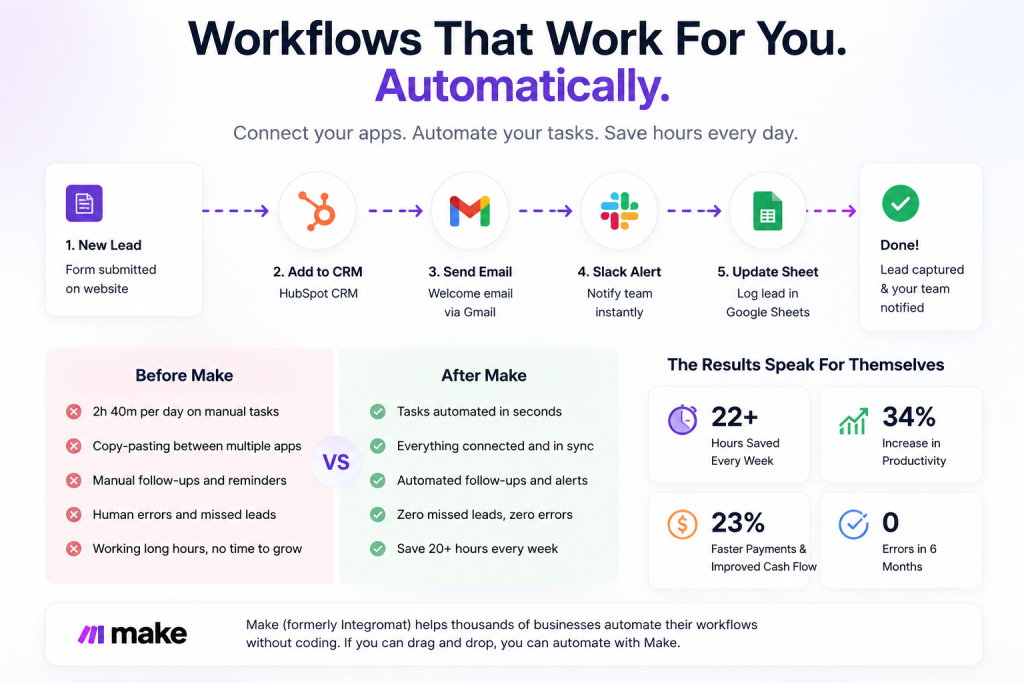
How Make transformed daily operations: automated lead management, reporting, invoicing, and client onboarding — saving more than 20 hours per week.
I want to give you real numbers, not vague promises.
Hours reclaimed per week: 22 hours. That’s more than half a full-time job. I now use that time to actually grow my business instead of administering it.
Revenue increase: +34% in 6 months. Not because Make magically makes money — but because I now have 22 extra hours per week to spend on revenue-generating work: client calls, content creation, partnerships.
Errors reduced to near zero. My VA made data entry errors about 3% of the time. Make has made exactly 0 errors in 6 months of running.
Cost: $16/month on the Individual plan. I cancelled the $800/month VA, the $49/month Zapier plan, and the separate social scheduling tool I was paying for. Net monthly saving: $846.
“I’m not exaggerating when I say Make.com gave me my life back. I work fewer hours, earn more, and my business runs while I sleep.”
Before Make After Make 22h/week admin 2h/week Manual reports Automated Manual onboarding Automated Slow invoicing Automated reminders
What Other People Are Saying
I’m not the only one. Since I started talking about Make publicly, dozens of people in my network have made the switch. Here’s what a few of them told me:
“I built my entire e-commerce order processing workflow in one weekend. 3,000+ orders processed automatically since then. Zero errors.”
— Thomas R., e-commerce entrepreneur
“As a freelancer, I was spending 30% of my time on admin. Make cut that to under 5%. I basically gave myself a raise without changing my rates.”
— Amelia D., independent consultant
“I manage 12 client accounts. Make automates the reporting, the social posting, and the lead tracking for all of them. I couldn’t scale without it.”
— James K., marketing agency owner
The One Thing I Wish I’d Known Before Starting
You don’t need to know how to code. You don’t need to understand APIs. You don’t need a technical background.
Make has a free plan that lets you run up to 1,000 operations per month — enough to test 2-3 full automations before spending a single dollar. The visual interface is genuinely intuitive: if you can draw a diagram, you can build a Make scenario.
The only thing I wish I’d done differently: I wish I’d started 14 months earlier. That’s 14 months of wasted mornings, cold coffee, and manual tasks that Make was already capable of handling.
If you are doing any of the following manually right now — data entry, email sequences, social posting, report generation, client onboarding, invoice follow-ups — Make.com can automate it. Usually in an afternoon.
How to Start Today (It’s Free)
Make.com has a free plan with no credit card required. You can build your first automation in about 20 minutes — I promise you will find it addictive.
Here’s exactly what to do:
- Create your free Make.com account here — no credit card, no commitment
- Think of the ONE task you repeat most often every day (data entry, emails, reporting — it doesn’t matter)
- Search for that task in Make’s template library — there are 1,700+ pre-built templates. Yours is almost certainly already there.
- Activate the template, connect your apps (takes 3 minutes), and watch it run for the first time
The first time you see your workflow execute automatically — doing in 8 seconds what used to take you 15 minutes — you’ll understand exactly what I felt that night at 1 AM.
Frequently Asked Questions
Do I need to know how to code to use Make.com?
No. Make.com is 100% visual — you connect apps and define workflows by dragging and dropping. No code, no technical knowledge required. If you can use a smartphone, you can use Make.
Is Make.com really free?
Yes. The free plan includes 1,000 operations per month — enough to run several real automations. Paid plans start at $9/month for higher volumes. Most small business owners and freelancers find the $16/month Individual plan more than sufficient.
How long does it take to build the first automation?
With a template: 15–20 minutes. From scratch: 45 minutes to 2 hours depending on complexity. The learning curve is fast — most users are building independently after a single day.
What apps does Make.com connect to?
Over 1,700 apps including Gmail, Google Sheets, Slack, HubSpot, Salesforce, Stripe, WordPress, Shopify, Notion, Airtable, Instagram, LinkedIn, and virtually every major business tool. If your app has an API (most do), Make can connect to it.
What’s the difference between Make.com and Zapier?
Make handles complex, multi-step workflows with conditional logic, data transformation, and error handling — at a significantly lower price point. For simple two-step automations, both tools work equally well. For anything more complex, Make wins on both power and cost.
Still manually copy-pasting, sending the same emails, building the same reports every week?
Start your free Make.com account now — and build your first automation today. The only thing you’ll regret is not starting sooner.
“This post contains affiliate links. If you sign up through our link, we earn a commission at no extra cost to you. All experiences shared are real and personal.”