


Engineering autonomous agent workflows — Engineering autonomous ai agent is one of the most important topics in AI and automation in 2026. Look, the world has enough prompt engineers. What we need are system architects. If you’re still copy-pasting text into a browser window, you’re missing the point of the current revolution. The real power lies in Autonomous AI Agent Workflows—systems that don’t wait for you to click “send.” These agents are designed to live inside your backend, monitoring data triggers and executing multi-step tasks while you sleep. We’re moving from human-in-the-loop to human-on-the-loop, and the efficiency gains are staggering.
The architecture of a “No-Prompt” system
The ultimate goal of any tech-forward firm is to eliminate the interface entirely. In an autonomous workflow, the agent doesn’t need a prompt; it needs a trigger. This could be a new row in a database, an incoming API call, or a specific change in market data. Once the trigger is activated, the agent follows a pre-defined logic branch to execute its task.
This isn’t just about speed; it’s about building a CRM Logic Engine that operates with surgical precision. When you pipe these models directly into your systems, you’re not asking the AI for help; you’re assigning it a role. This is the foundation of the autonomous business systems we discussed in our Autonomous Enterprise Manifesto.
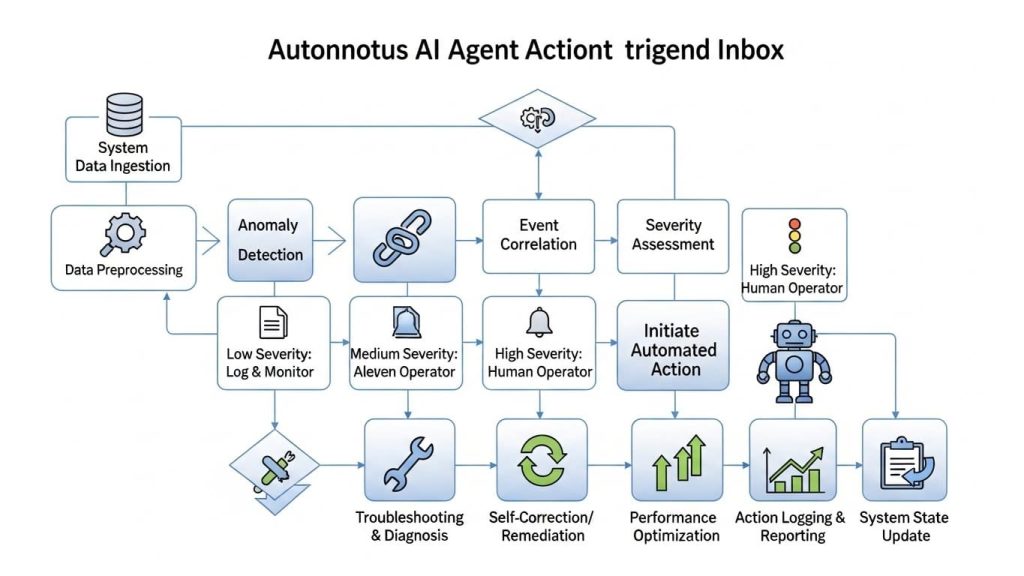
Agent Autonomy and Multi-Step Execution
Standard automation moves in a straight line: if A happens, do B. But Autonomous AI Agent Workflows are non-linear. They can evaluate the quality of an output and decide to re-run a step or branch off into a different process entirely. This is what separates a basic script from an “employee” grade system. For example, if an agent is tasked with researching a lead, it doesn’t just scrape a website; it cross-references data, validates emails, and then decides whether that lead belongs in your high-priority Self-Healing Sales Funnel.
By leveraging multi-step execution, you reduce the need for manual oversight. You can build loops where one agent generates a draft, a second “critic” agent reviews it against your brand guidelines, and a third agent handles the distribution. This chain of command happens in the background, ensuring that your Autonomous Business Systems are always moving toward a result without hitting a human bottleneck.
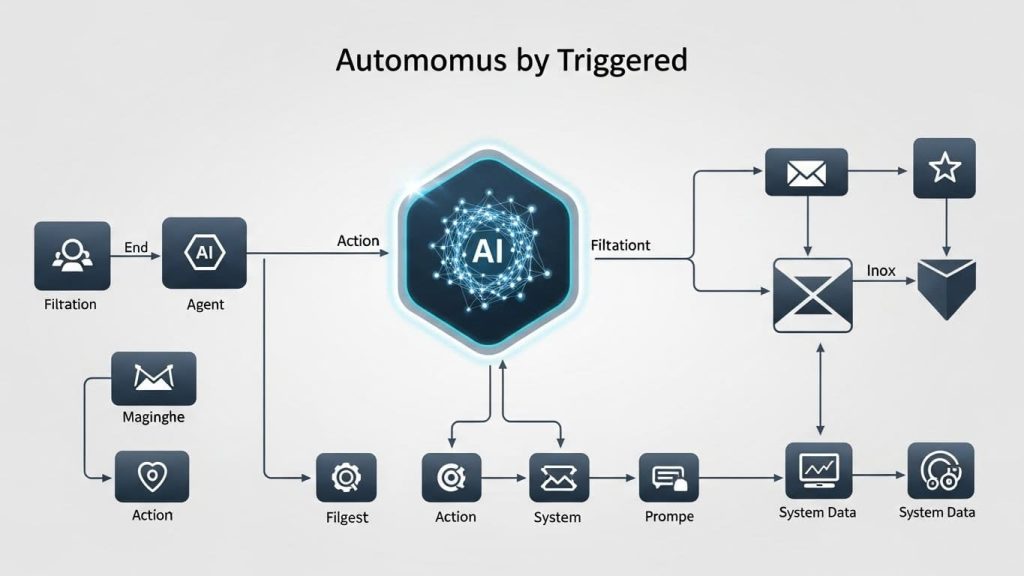
The ROI of “No-Touch” Backend Operations
The real win of these workflows isn’t just “saving time”—it’s the massive increase in Closing Rates and operational velocity. When you implement this playbook, your team stops acting as the “filter” and starts acting as the “architect.” By the time a human interacts with a process, the AI agent has already done the 90% of the grunt work—scoring, cleaning, and preparing the data.
As we’ve noted in our Autonomous Enterprise Manifesto, the tools are ready. The question is: are you ready to stop being the manual bridge between your apps? By piping these agents into your Financial Operations Automation, you ensure that every part of your business is working in sync, 24/7, without the high cost of a massive backend team.
Conclusion
Stop thinking about AI as a chat box and start thinking about it as the engine of your infrastructure. Autonomous agent workflows are the secret to scaling in 2026 without losing your mind—or your margin.
Key Benefits of Engineering Autonomous AI Agent Workflows
Understanding the core advantages helps you make informed decisions and implement the right approach for your specific context. Here are the most significant benefits that practitioners consistently report:
- Time savings at scale: Once properly configured, Engineering Autonomous AI Agent Workflows reduces manual effort by 60-80% on repetitive tasks, freeing your team to focus on high-value creative and strategic work.
- Consistency and reliability: Unlike manual processes that vary based on who executes them and when, a well-built Engineering Autonomous AI Agent Workflows system delivers the same quality output every time, regardless of volume.
- Measurable ROI: The cost savings and output gains from Engineering Autonomous AI Agent Workflows are directly trackable. Most teams that implement it properly see a positive return within the first 30-60 days.
- Scalability without proportional cost: You can multiply output 5x or 10x without multiplying your team size or budget. This is the fundamental leverage that makes Engineering Autonomous AI Agent Workflows a competitive advantage.
- Reduced error rates: Automated and AI-assisted systems eliminate the class of errors that come from fatigue, distraction, and human inconsistency — particularly valuable in high-volume operations.
Implementation Checklist for Engineering Autonomous AI Agent Workflows
Use this checklist to track your implementation progress and ensure you’re not missing critical steps:
Phase 1: Foundation (Week 1)
- ☐ Document your current process end-to-end (every step, every decision point)
- ☐ Identify which steps require human judgment vs. which are mechanical and repeatable
- ☐ Define 2-3 success metrics you’ll track from day one
- ☐ Choose your tool stack and verify integrations work before building
- ☐ Set up a test environment separate from your production workflow
Phase 2: Build (Week 2-3)
- ☐ Build the simplest version of the system first — no edge cases yet
- ☐ Test with real data, not synthetic test data
- ☐ Add error handling and failure notifications before going live
- ☐ Document the system so someone else can maintain it
- ☐ Get sign-off from all stakeholders who will interact with the system
Phase 3: Launch and Optimize (Week 4+)
- ☐ Run in parallel with the manual process for the first week
- ☐ Review outputs daily for the first 2 weeks
- ☐ Track your success metrics weekly
- ☐ Identify the next process to automate based on what you’ve learned
- ☐ Schedule a quarterly review of the system’s performance
Common Mistakes to Avoid with Engineering Autonomous AI Agent Workflows
Most teams that struggle with Engineering Autonomous AI Agent Workflows are not failing because the technology doesn’t work — they’re failing because of predictable, avoidable mistakes. Here are the most common ones:
1. Trying to automate everything at once
The teams that succeed with Engineering Autonomous AI Agent Workflows start with one specific, well-defined process and get it working reliably before expanding. The teams that fail try to automate their entire operation in week one and end up with a fragile system nobody trusts.
2. Skipping the process documentation phase
Before you can automate or optimize a process, you need to understand exactly how it works today. Teams that skip this step build systems that automate the wrong version of the process — including all its existing inefficiencies.
3. Not defining success metrics upfront
If you don’t know what “working well” looks like before you start, you’ll never know if your implementation of Engineering Autonomous AI Agent Workflows is actually delivering value. Define 2-3 concrete metrics before you build anything.
4. Underinvesting in the human review layer
The most effective Engineering Autonomous AI Agent Workflows implementations keep humans in the loop at the right decision points. Removing all human oversight to maximize automation speed is how quality problems compound silently until they become crises.
5. Not planning for maintenance
Every system requires ongoing maintenance. APIs change, data structures evolve, business requirements shift. Budget time and responsibility for keeping your Engineering Autonomous AI Agent Workflows system current — it’s not a one-time build.
Recommended Tools for Engineering Autonomous AI Agent Workflows in 2026
The right tools make the difference between a fragile prototype and a production-grade system. These are the tools most consistently used by practitioners who have built reliable Engineering Autonomous AI Agent Workflows workflows:
- Make.com — The automation backbone for connecting tools and building workflow logic without code. Handles complex branching, error handling, and data transformation better than alternatives at this price point.
- Claude (Anthropic) — Best for structured reasoning, long-form content tasks, and workflows requiring consistent output quality. Particularly strong for tasks that need nuanced judgment rather than just speed.
- n8n — The self-hosted alternative to Make for teams that need full data control or want to avoid per-operation pricing. Steeper learning curve, significantly lower cost at scale.
- Airtable or Notion — For managing the data layer of your workflow: tracking inputs, outputs, approvals, and status without building a custom database.
- RankMath or Yoast — For any workflow that touches WordPress content, these plugins provide the API hooks needed to update SEO metadata, schedule posts, and manage publishing programmatically.
The specific combination you choose matters less than ensuring the tools integrate cleanly with each other. Before committing to any stack, verify that the data can flow between tools in the format each tool expects.
Frequently Asked Questions
What is the most important thing to get right with Engineering Autonomous AI Agent Workflows?
Clarity on the problem you’re solving before you start building. The teams that struggle most are the ones that start building before they have a precise definition of the outcome they want to achieve.
How do I measure success?
Define 2-3 concrete metrics before you start: time saved per week, error rate reduction, output volume increase. Measure these from day one so you can demonstrate value and know when to optimize.
How do I get buy-in from my team or leadership?
Run a small, time-boxed pilot on a low-risk process. Measure the results. Present the numbers. Nothing convinces faster than a working proof of concept with real data from your own operation.
Where should I start if I’m new to Engineering Autonomous AI Agent Workflows?
Start with a process you already understand well and that has a clear, measurable output. Don’t start with your most complex or most critical process. Start with something you can afford to get wrong, learn from, and redo. That first build teaches you more than any course or guide.
Final Thoughts on Engineering Autonomous AI Agent Workflows
The gap between teams that benefit from Engineering Autonomous AI Agent Workflows and teams that don’t is rarely about access to tools or budget. It’s about approach. The teams that succeed treat it as a discipline — something they learn systematically, implement incrementally, and improve continuously. The teams that fail treat it as a switch they can flip once and forget.
If you take one thing from this guide: start smaller than you think you should. Pick the most contained, well-understood process in your operation. Build it. Measure it. Then expand. Every large-scale Engineering Autonomous AI Agent Workflows system you’ve ever admired was built the same way — one reliable module at a time.
The tools in 2026 are better than they’ve ever been. The information is more accessible than ever. The only variable left is whether you act on it.