

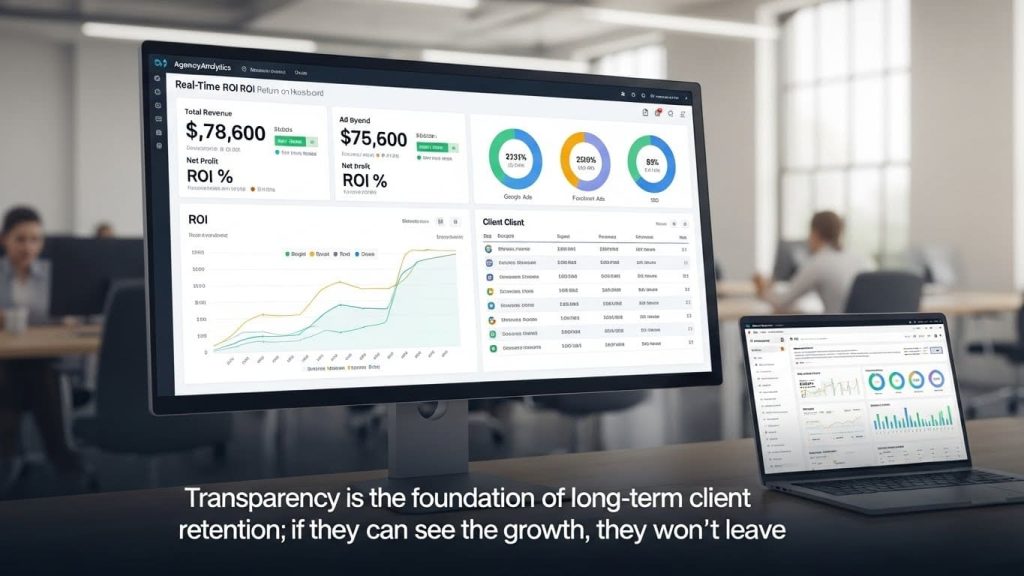
Agency analytics review 2026 is one of the most important topics in AI and automation in 2026. The final piece of an elite tech stack isn’t about doing the work—it’s about proving the work. In a world where clients are bombarded by “AI agencies” making empty promises, transparency is your most lethal weapon. If you don’t have a real-time mirror showing the client their ROI, you are replaceable. AgencyAnalytics is the tool that turns your agency from an expense into a measurable investment.
The “Friday Afternoon Report Panic” is a relic of the past. If you are still manually taking screenshots of Facebook Ads and pasting them into a slide deck, you are operating in 2018. In 2026, the AI tech stack for agencies 2026 requires live data streams.
AgencyAnalytics has become the industry standard for lean agencies because it automates the most tedious part of the business: The Proof. By integrating this into your business operations, you provide a level of professionalism that justifies high-ticket retainers.
Centralizing the Truth: 75+ Integrations
The power of AgencyAnalytics lies in its ability to act as a “Data Vacuum.” It sucks in data from every corner of your AI-first infrastructure and presents it in a way that a CEO can understand in 5 seconds.
- All-in-One Visibility: Connect Google Ads, Meta, TikTok, Shopify, and even GHL (via Webhooks) into one dashboard.
- White-Label Portals: Your clients get their own login to a dashboard that carries your branding, reinforcing your authority every time they check their stats.
- Automated Call Tracking: Integrates with tools like CallRail to show exactly how many phone calls your ads generated.
The 2026 AI Reporting Edge: Predictive Insights
Reporting is usually “reactive”—it tells you what happened last month. AgencyAnalytics has introduced AI-driven Predictive Insights that change the conversation.
- Anomaly Detection: The system pings you automatically if a client’s Cost Per Lead (CPL) suddenly spikes, allowing you to fix it before the client even notices.
- Smart Comments: Instead of you writing a summary, the AI analyzes the data and writes a professional executive summary of the “Wins” and “Opportunities” for that week.

Pros & Cons: Is It Worth the Subscription?
In our tech stack budget guide, we prioritize tools that reduce “Client Churn.” AgencyAnalytics is the ultimate churn-killer.
The Pros:
- Saved Time: Saves an average of 15–20 hours per month of manual reporting per account manager.
- SEO Tools: Includes built-in rank tracking and site audits, eliminating the need for separate SEO tools.
- Goal Tracking: You can set specific “Targets” (e.g., 100 leads/month), and the client can see a progress bar moving in real-time.
The Cons:
- Pricing Tiers: It can get expensive as you add more clients.
- Customization Limits: While powerful, the dashboard layouts are somewhat fixed compared to a tool like Looker Studio.
Final Verdict: The Accountability Engine
If you want to move away from “trust me” to “look at this,” AgencyAnalytics is mandatory. It is the final link in the chain that connects your lead generation systems to the client’s bank account.
Ready to automate your proof of value? Check out our Case Studies to see the exact dashboard layouts we use for 7-figure agencies, or visit our Resources section for a 30-day reporting automation challenge.
Key Benefits of Agency Analytics Review 2026: The
Understanding the core advantages helps you make informed decisions and implement the right approach for your specific context. Here are the most significant benefits that practitioners consistently report:
- Time savings at scale: Once properly configured, Agency Analytics Review 2026: The reduces manual effort by 60-80% on repetitive tasks, freeing your team to focus on high-value creative and strategic work.
- Consistency and reliability: Unlike manual processes that vary based on who executes them and when, a well-built Agency Analytics Review 2026: The system delivers the same quality output every time, regardless of volume.
- Measurable ROI: The cost savings and output gains from Agency Analytics Review 2026: The are directly trackable. Most teams that implement it properly see a positive return within the first 30-60 days.
- Scalability without proportional cost: You can multiply output 5x or 10x without multiplying your team size or budget. This is the fundamental leverage that makes Agency Analytics Review 2026: The a competitive advantage.
- Reduced error rates: Automated and AI-assisted systems eliminate the class of errors that come from fatigue, distraction, and human inconsistency — particularly valuable in high-volume operations.
Common Mistakes to Avoid with Agency Analytics Review 2026: The
Most teams that struggle with Agency Analytics Review 2026: The are not failing because the technology doesn’t work — they’re failing because of predictable, avoidable mistakes. Here are the most common ones:
1. Trying to automate everything at once
The teams that succeed with Agency Analytics Review 2026: The start with one specific, well-defined process and get it working reliably before expanding. The teams that fail try to automate their entire operation in week one and end up with a fragile system nobody trusts.
2. Skipping the process documentation phase
Before you can automate or optimize a process, you need to understand exactly how it works today. Teams that skip this step build systems that automate the wrong version of the process — including all its existing inefficiencies.
3. Not defining success metrics upfront
If you don’t know what “working well” looks like before you start, you’ll never know if your implementation of Agency Analytics Review 2026: The is actually delivering value. Define 2-3 concrete metrics before you build anything.
4. Underinvesting in the human review layer
The most effective Agency Analytics Review 2026: The implementations keep humans in the loop at the right decision points. Removing all human oversight to maximize automation speed is how quality problems compound silently until they become crises.
5. Not planning for maintenance
Every system requires ongoing maintenance. APIs change, data structures evolve, business requirements shift. Budget time and responsibility for keeping your Agency Analytics Review 2026: The system current — it’s not a one-time build.
Recommended Tools for Agency Analytics Review 2026: The in 2026
The right tools make the difference between a fragile prototype and a production-grade system. These are the tools most consistently used by practitioners who have built reliable Agency Analytics Review 2026: The workflows:
- Make.com — The automation backbone for connecting tools and building workflow logic without code. Handles complex branching, error handling, and data transformation better than alternatives at this price point.
- Claude (Anthropic) — Best for structured reasoning, long-form content tasks, and workflows requiring consistent output quality. Particularly strong for tasks that need nuanced judgment rather than just speed.
- n8n — The self-hosted alternative to Make for teams that need full data control or want to avoid per-operation pricing. Steeper learning curve, significantly lower cost at scale.
- Airtable or Notion — For managing the data layer of your workflow: tracking inputs, outputs, approvals, and status without building a custom database.
- RankMath or Yoast — For any workflow that touches WordPress content, these plugins provide the API hooks needed to update SEO metadata, schedule posts, and manage publishing programmatically.
The specific combination you choose matters less than ensuring the tools integrate cleanly with each other. Before committing to any stack, verify that the data can flow between tools in the format each tool expects.
Frequently Asked Questions
Is Agency Analytics Review 2026: The worth the investment in 2026?
For teams with a clear use case and the volume to justify it, yes. The key is having a specific problem to solve before purchasing — not buying the tool and then looking for problems to apply it to.
What are the biggest limitations?
Every tool has limitations that only become apparent in production. The most common ones are rate limits under high volume, edge cases in data handling, and integration gaps with niche tools in your existing stack.
How long does it take to get value?
Teams that commit to learning the tool properly typically see meaningful results within 2-4 weeks. Teams that try to use it without investing time in understanding it typically give up in week one.
Where should I start if I’m new to Agency Analytics Review 2026: The?
Start with a process you already understand well and that has a clear, measurable output. Don’t start with your most complex or most critical process. Start with something you can afford to get wrong, learn from, and redo. That first build teaches you more than any course or guide.
Final Thoughts on Agency Analytics Review 2026: The
The gap between teams that benefit from Agency Analytics Review 2026: The and teams that don’t is rarely about access to tools or budget. It’s about approach. The teams that succeed treat it as a discipline — something they learn systematically, implement incrementally, and improve continuously. The teams that fail treat it as a switch they can flip once and forget.
If you take one thing from this guide: start smaller than you think you should. Pick the most contained, well-understood process in your operation. Build it. Measure it. Then expand. Every large-scale Agency Analytics Review 2026: The system you’ve ever admired was built the same way — one reliable module at a time.
The tools in 2026 are better than they’ve ever been. The information is more accessible than ever. The only variable left is whether you act on it.